Year 1995, summer break, time moved differently. Instead of the courtyard, I sat at my monitor typing commands into DOS, because launching a game back then was its own little ritual. Gladiator by Forgotten Sages was one of those titles nobody really remembers, but whoever fell into it spent more time with it than they'd admit.
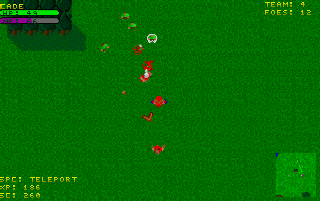
The game puts you in the shoes of a commander of a small mercenary band set in a medieval setting. You start with a handful of fighters, gradually recruit new ones, train them, and embark on missions. Top-down view, real-time action, but with emphasis on team management. It's not purely about bashing — there's a layer of planning: who to take into the field, how to equip them, how to keep them alive at all.
Gameplay rests on a simple principle: you control one character at a time, the rest of the group moves with you or waits. That sounds limiting at first glance, but in practice it gives you a real sense of responsibility for each soldier. Lose an experienced fighter, and you feel it. Difficulty levels — from light skirmishes to hard mode — give the game decent longevity, though by today's standards it's all fairly modest in content. Controls are straightforward, interface typically of its era — functional, but without unnecessary comfort.
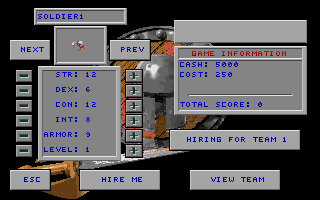
Forgotten Sages weren't some big studio, and Gladiator moved in the gray zone of shareware distributions rather than store shelves back then. What holds up even today is that basic loop: arrive, hire, train, survive. It ages well where it doesn't exceed its own scope. It ages poorly in moments when the AI of your companions does what AI of that era always did — make decisions that are hard to describe as intelligent. Graphics are functional isometric pixelart of the time, nothing more.
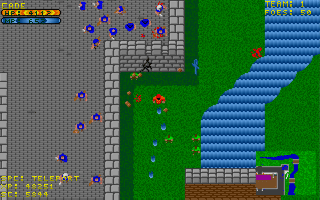
Today, Gladiator will appeal to anyone looking for uncomplicated action with a dash of tactics who doesn't want to spend hours reading manuals. Fire it up in your browser via DOSBox emulation with no prep, and in half an hour you'll know exactly whether it grabs you or not. Nineties nostalgics will find that characteristic feel in it — a game that doesn't pretend to be anything, just works and lets you play. I don't want more from it than that.
 old
old


 ▶Doom1993MS-DOS / PCGrand Theft Auto (DMA Design)▶Grand Theft Auto (DMA Design)1997MS-DOS / PC


 ▶Contra1988MS-DOS / PC

 ▶Ultimate Mortal Kombat 31996Super Nintendo
