Five cards. One opponent. No illusions about what you're here for. Cover Girl Strip Poker from 1991 doesn't waste a single frame pretending to be something else — it's a DOS poker game built around a single incentive, delivered with the subtlety of a brick through a window.
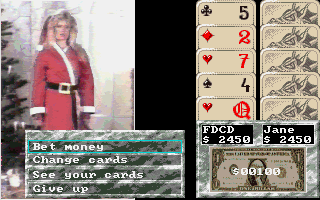
The setup is exactly what it sounds like. You sit across from a digitized model, play standard five-card draw poker, and if the cards fall your way, her wardrobe follows. That's the entire game. No tournament bracket, no story, no unlockable opponents. One table, one opponent, one goal that a twelve-year-old in 1991 would have died rather than explain to his parents.
The poker itself is functional, nothing more. You get your five cards, choose what to hold, draw replacements, and the hand resolves. The AI isn't trying to bluff you into a mistake or read your tendencies — it plays mechanically, which means the whole session is basically a long session with a random number generator wearing lipstick. The interface is clean enough for DOS standards, clicking through menus works without drama, and the pace is slow and deliberate in a way that felt normal in 1991 and feels like watching paint dry in 2024.
What Cover Girl Strip Poker actually represents is a specific slice of early PC culture — the part nobody put in the brochure. Games like this circulated on floppy disks passed hand to hand, downloaded overnight from BBS boards on a modem that sounded like two robots arguing. The digitized photography was genuinely novel for the time. Putting a real photographic image on a PC screen in 1991 still required some effort, and seeing it there, on a 256-color VGA monitor, had an impact that's completely impossible to reconstruct today. The technology carried the experience. Strip it away — which time has done entirely — and what's left is a poker game that wouldn't pass muster as a solitaire bonus round.
It has aged about as well as you'd expect. The poker AI offers no real challenge, the single-opponent structure exhausts itself in minutes, and the central hook has been rendered obsolete by approximately the entire internet. Playing it today is more archaeological than entertaining — a document of what passed for transgressive entertainment when a 40MB hard drive was a luxury purchase. If you remember hunting down games like this in the early nineties, firing it up in the browser will hand you a precise, slightly uncomfortable slice of that era. If you didn't live it, there's almost nothing here for you. As poker games go, you'd be better served by the freecell that shipped with Windows 3.1.
 old
old


 ▶Teenage Queen1988MS-DOS / PC


 ▶Mario is Missing!1992MS-DOS / PC

 ▶Vlak1993MS-DOS / PC


 ▶Chess1998Sega Mega Drive
 ▶Sokoban1984MS-DOS / PC
 ▶Boulder Dash1984MS-DOS / PC
 ▶CD-Man1989MS-DOS / PC