 old


 ▶The Simpsons Arcade Game1991MS-DOS / PC


 ▶Dangerous Dave1990MS-DOS / PC


 ▶NewMravenečci2026Webová hra


 ▶Streets of Rage 21992Sega Mega Drive
 ▶Pinball Fantasies1992MS-DOS / PC


 ▶Frogger1983MS-DOS / PC

 ▶Star Wars1988MS-DOS / PC
 ▶Pheenix1983ZX Spectrum

 ▶Digger1983MS-DOS / PCBomber Man World▶Bomber Man World1992Arcade (MAME)

 ▶Alley Cat1984MS-DOS / PC


 ▶CHAMP Pac-em1996MS-DOS / PC
 ▶Skyroads1993MS-DOS / PC


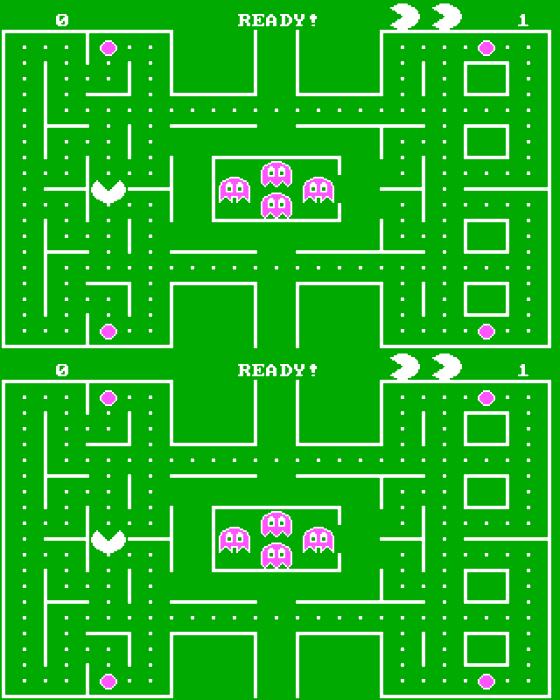 ▶PacmanMS-DOS / PC


Coin-op design is its own discipline, and the arcade games in this section still show the fingerprints of the cabinet. A player had roughly thirty seconds to understand the rules from the attract mode, and the machine had to take money at a steady rate. That is why Pac-Man teaches you everything in one maze, and why Nintendo built Donkey Kong as four screens that loop with the timer squeezed a little tighter each round.
Why the difficulty curve looks like that
Arcade titles were not balanced for fairness, they were balanced for turnover. Scores mattered because the high-score table was the only progression system available, and the initials you left behind were the whole reward. That economy produced very specific habits: patterns to memorise, safe spots to exploit, and enemies whose behaviour is deterministic enough to be learned but complex enough to punish sloppiness. Ports to home machines inherited the shape but not always the timing — the conversions from that era are worth playing precisely because you can feel where the hardware ran out. Atari Games pushed the format somewhere odd with Marble Madness, replacing lives and shooting with a trackball, six isometric courses and a clock, and it still feels unlike anything else.
These are the original releases from the catalogue, not rewritten versions. Anything marked playable runs directly in the browser on an emulator embedded in the page: no installation, no plugin, no registration and nothing to download. Insert-coin screens included, because they are part of how these games were meant to be read.