 old
old


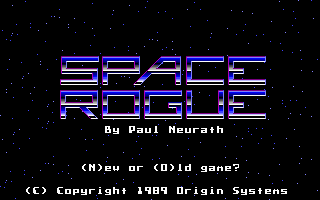 ▶Space Rogue1989MS-DOS / PC


Space was the setting that early computers handled best. A star field costs almost nothing to draw, a galaxy can be generated from a formula instead of stored on disk, and nobody complains that the physics look wrong. That combination produced an unusually strong run of space games between the mid-1980s and the late 1990s, spanning trading simulators, fleet strategy, cockpit combat and comedy adventures.
The foundation is Elite, written by David Braben and Ian Bell and first released in 1984. It fitted eight galaxies of trading, piracy and bounty hunting into a machine with 32 kilobytes of memory by generating the star systems procedurally rather than storing them. There was no plot and no ending, only a rank that slowly climbed while you decided what kind of pilot to be. Braben continued the line with Frontier: Elite II and Frontier: First Encounters, which added Newtonian flight and a full solar-system scale.
The cockpit-and-story branch belongs to Origin Systems. Wing Commander, designed by Chris Roberts and released in 1990, put dogfights between briefing-room scenes and let the campaign branch depending on whether you won or lost. LucasArts answered with X-Wing and TIE Fighter, which took the same structure into the Star Wars universe and are widely considered the high point of the space-sim era.
Strategy took a different route. Master of Orion, developed by Simtex and published by MicroProse in 1993, compressed empire building, ship design and diplomacy into a game you could finish in an evening, and effectively defined the 4X space genre. Star Control II mixed arcade ship duels with a large, funny galaxy of alien races, while Starflight and Protostar leaned toward exploration and survey work. Comedy is represented by Sierra's Space Quest series, in which the janitor Roger Wilco keeps saving the galaxy by accident.
Titles marked as playable start directly in the browser through an emulator, with no installation and no account.