Doom, released by id Software in December 1993, is one of the most important games ever made and effectively defined the first-person shooter as we know it. You play a lone space marine stationed on Mars' moons when a demonic invasion pours through from a botched teleportation experiment, and the game hands you a shotgun and turns you loose. The paper-thin plot was entirely deliberate — id's John Carmack famously compared story in a game to story in a porn film — and the focus is squarely on fast, visceral, endlessly replayable combat.
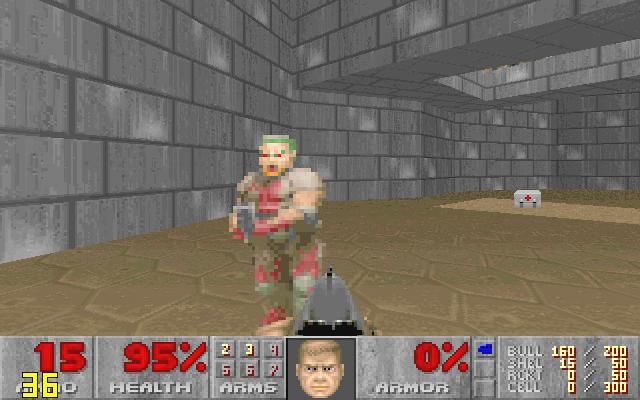
Technically it was a leap forward. Its engine rendered varied heights, dramatic lighting and non-orthogonal walls that made Wolfenstein 3D look flat by comparison, all running at a speed that felt exhilarating on the hardware of the day. The design encouraged constant movement — circle-strafing packs of imps and demons, hunting for keycards and secret rooms stuffed with power-ups, and revelling in weapons like the chainsaw, the plasma rifle and the mighty BFG 9000.
Doom's cultural footprint is enormous. It popularized deathmatch multiplayer, its shareware distribution model spread it to millions of machines, and its open approach to WAD editing created one of gaming's most enduring modding communities — people still build new levels for it more than thirty years on. It has since been ported to almost every device imaginable, a running joke that speaks to how lean and adaptable the code is. As pure action it remains razor-sharp today.
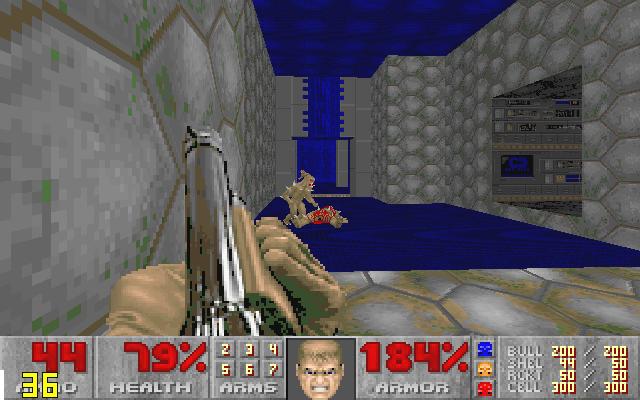
The original 1993 Doom is split into episodes of nine maps each (eight main levels plus one secret). The shareware release contained only the first episode; the registered version added two more, and 1995's Ultimate Doom appended a fourth:
- Knee-Deep in the Dead — the Phobos base: tech corridors and generous ammo. The perfect warm-up, capped by E1M8 Phobos Anomaly and its two Barons of Hell.
- The Shores of Hell — a warped Deimos installation where the difficulty climbs. E2M8 Tower of Babel puts you face to face with the Cyberdemon.
- Inferno — Hell itself, with the nastiest mazes and the meanest ambushes. The Spider Mastermind rules E3M8 Dis.
- Thy Flesh Consumed — the bonus fourth episode in Ultimate Doom, built for veterans. Do not start here.
For newcomers we recommend Hurt Me Plenty, the third of five skills. It throws enough monsters at you to keep the game honest while leaving health and ammo pickups workable. Save Ultra-Violence for your second run.

- Never stand still. Strafing is the core skill — enemy projectiles are slow and are dodged by stepping sideways, not by backing away.
- Conserve ammo. The shotgun handles zombies and imps; keep rockets and plasma for Barons and Cacodemons. Fire in taps, not long bursts.
- Hunt for secrets. They give themselves away through mismatched wall textures, an odd shade, a crack, or light with no visible source. Press the use key against any suspicious wall.
- The chainsaw (E1M2) is your free answer to imps and zombies — close the gap and hold the trigger, it never runs dry.
- Bosses: the Cyberdemon and Spider Mastermind carry huge health pools but no defenses. Circle-strafe, shoot from the flank and keep pillars between you. Two BFG hits drop the Cyberdemon; the Mastermind can be rocketed down — just never let it get a clear line on you.
Browser controls: arrow keys or WASD to move, Ctrl to fire, Space to open doors and hit switches, Alt + arrows to strafe, Shift to run, keys 1–7 to swap weapons.
 old
old


 ▶Contra1988MS-DOS / PC


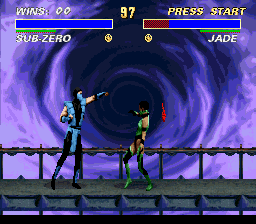 ▶Ultimate Mortal Kombat 31996Super Nintendo


 ▶Mortal Kombat II1993Super Nintendo