There are racing games that put you on a track. Crazy Cars 3 puts you on a highway, points you at oncoming traffic, and says good luck. That tells you everything about what Titus was going for in 1992.
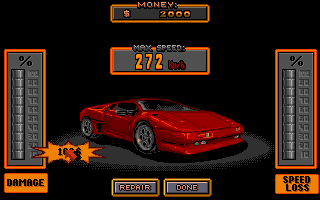
This is the third and final entry in the French studio's arcade racing series, running on MS-DOS. You pick a car, you pick a route across real American roads — or something that passes for them — and you race against the clock while dodging regular civilian traffic going the other way. No closed circuit, no neat little starting grid. Just asphalt, speed, and the constant threat of a head-on collision with a truck that doesn't care about your lap time.
The handling sits somewhere between arcade and early pseudo-simulation, which in practice means your car slides a bit too much and corners feel like suggestions rather than physics. At high speeds the screen fills up fast and you need to read traffic a second or two ahead, which is the closest thing the game has to genuine tension. There's an upgrade system tucked in there — you can bolt better engines and parts onto your vehicle between runs — and that loop of earning money, improving the car, then pushing further gave the whole thing more structure than you'd expect from something this chaotic. The rocket engine upgrade is real, and yes, it's as stupid as it sounds, and yes, you will want it immediately.
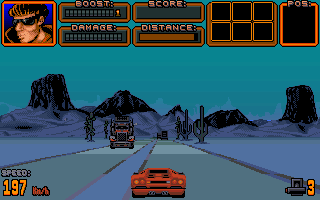
What made Crazy Cars 3 stick in the memory isn't polish. The graphics are functional at best, the sound effects have that flat, slightly hollow quality that PC speakers did before proper sound cards became standard, and the AI opponents aren't exactly keeping you up at night. What it had was momentum. The sense that you're always going slightly too fast for your own good, that the next truck might be the one you don't dodge in time. That particular flavor of low-budget, high-velocity arcade chaos that French developers like Titus were quietly quite good at in the early nineties — unpretentious, immediate, disposable in the best sense.
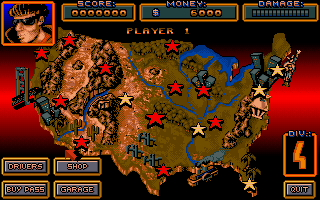
By modern standards it's rough. The perspective warps at speed in ways that feel accidental rather than stylish, and there's no getting around the fact that the difficulty spike is steep and unforgiving in ways that have more to do with limitations than design intent. It does not run in the browser here — the page carries a description, screenshots and the release data. If you spent any time in the early nineties watching someone else play this at a school computer and being told to wait your turn, now's your chance.
 old
old


 ▶Test Drive1987MS-DOS / PC


 ▶F11993Sega Mega Drive
 ▶Pitstop II1984MS-DOS / PC


