There's a moment in Dungeon Master 2 where you step through a door and the ceiling disappears. No more stone walls pressing in. You're outside, under an open sky, and your brain quietly short-circuits because nobody told you this was supposed to happen. That single moment cost me about twenty minutes of standing still and staring at a VGA landscape like an idiot.
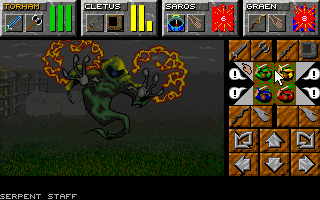
Dungeon Master 2: Legend of Skullkeep arrived on PC in 1994, a follow-up to FTL Games' 1987 original that had essentially taught an entire generation how real-time dungeon crawling was supposed to feel. The sequel landed under Interplay's banner and pushed the formula outward — literally. You still have a party of up to four adventurers, still shuffle through grid-based environments in first person, still drag food and weapons around a cramped inventory like you're packing a very dangerous lunchbox. But the game breaks its own dungeon walls and introduces outdoor areas, a small town, and a wider sense of place that the original never attempted.
The core mechanics will be immediately familiar to anyone who survived the first game. Movement is tile-by-tile, combat happens in real time with direct mouse clicks on weapon slots, and magic still runs on a rune-combination system that rewards obsessive experimentation. Enemies patrol, react, and can follow you through doors, which remains genuinely unpleasant at two in the morning with headphones on. The interface hadn't changed dramatically — it's still that dense, icon-heavy panel that looks like the cockpit of something that was never meant to fly — but by 1994 that was starting to feel less like elegance and more like stubbornness. Ultima Underworld had already shown the world what immersive first-person RPGs could look like, and the comparison wasn't flattering to either side.
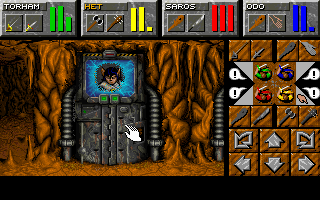
What Skullkeep gets right is atmosphere and a genuine sense of discovery. The outdoor sections aren't vast open worlds, but they break the claustrophobia in ways that still feel considered rather than bolted on. The dungeon design in the later sections is mean in the good way — pressure plates, timed puzzles, doors that only open when you're standing somewhere you really don't want to be standing. It zestárlo — sorry, it aged — unevenly. The puzzle logic occasionally crosses from clever into arbitrary, and without a hint system or in-game documentation you will at some point spend forty minutes throwing rocks at walls on pure blind hope. Some walls deserved it. Most didn't.
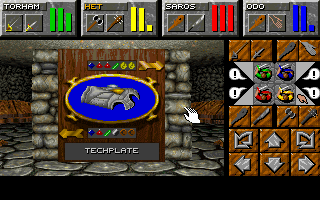
Today this one belongs to people who played the original and want to see where it went, or to patient dungeon-crawl enthusiasts who appreciate a game that demands attention rather than bribing it. Running it in a browser through DOSBox-based emulation is painless, and the game still lands its atmosphere even on a modern screen. The Sound Blaster soundtrack is bleak and metallic in exactly the right way. Some things age like wine. Dungeon Master 2 ages like a good pocketknife — still sharp, still useful, just obviously from another era.
 old
old


 ▶Light Crusader1995Sega Mega Drive


