1982, an arcade hall somewhere in America, and I've got a chef in a white hat running across giant hamburger ingredients while dodging frantic hot dogs in buns. I was seven when I first saw it with my own eyes, but when BurgerTime landed on home computers, I understood immediately what it was all about.
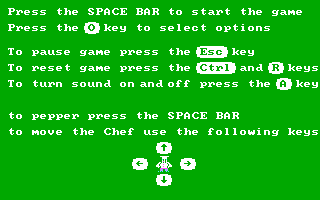
Data East created an arcade game whose premise is so absurd that it works without a single word of explanation. You play as Chef Peter Pepper, who must traverse hamburger ingredients — bun, lettuce, meat, tomato — and stack them floor by floor down into plates. Who's stopping him? Hostile eggs, hot dogs, and pickles. Kitchen logic has never been a strong point for the genre, but here it somehow clicks.
The game is pure arcade puzzle with time pressure. You cross ingredients left and right, enemies chase you across ladders and platforms, and you search for ways to squash them under a falling layer of lettuce or bun. You've got a limited supply of pepper — your only weapon — which stuns anything in range for a moment. The mechanics are simple, but the combination of enemy movement, route selection, and pepper conservation creates exactly that reasonably frustrating loop that had me losing again and again and again. Difficulty ramps up fast. The third screen will make you feel like you're in a three-Michelin-star restaurant kitchen during rush hour.
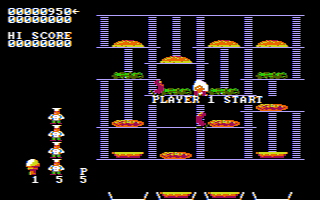
BurgerTime belongs to that generation of games where there's no story, no save system, no equipment. Just score and the will to survive. For what it is — a straight port of early-eighties arcade — it holds up surprisingly well in playability. Not because it aged gracefully, but because the core loop is so streamlined there was nothing to fall apart. What aged worse is the visual side of the PC version; the arcade original looked livelier, the home port was a necessary compromise of the hardware at the time. The sounds are right at that threshold where the headache begins.
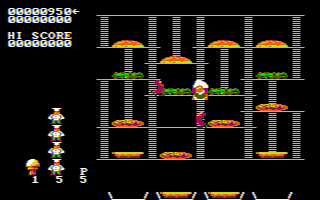
Today BurgerTime will appeal to anyone craving ten minutes of pure arcade tension with no tutorials and no installation required. It runs flawlessly in a browser through DOSBox emulators, and it's one of those titles you'll fully understand in thirty seconds and master only after thirty attempts. If you missed it in the nineties, it's not too late. The hot dogs are waiting for you.
 old
old


 ▶Doom1993MS-DOS / PC


 ▶Ultimate Mortal Kombat 31996Super Nintendo


