I remember it perfectly: an empty classroom, a classmate brought some floppy disks, and someone shouted "a racing game from Sega." In 1990, that was a magic phrase. Sega meant arcades, it meant something you didn't have at home.
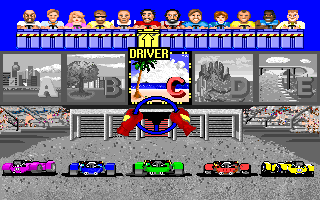
Power Drift hit arcades in 1988 and within a year it rolled across home platforms — ZX Spectrum, Commodore 64, Amiga, Atari ST, and finally MS-DOS in 1990. It's a behind-the-wheel racing game with a heavily arcade approach. You're not sitting in a Formula cockpit or on a motorcycle — your vehicle is a sand buggy, a lightweight racing cart that behaves more like a pinball in a machine than an actual car on twisting tracks.
The courses are varied, chunky, packed with turns, hills and valleys that looked almost magical back then — sprite scaling was working at full throttle, delivering the illusion of speed. Controls are simple: gas, brake, left, right. No gear shifting, no vehicle tuning. The difficulty comes from trajectories and dense opponent traffic, not complicated mechanics. That's intentional, not a shortcoming — it's an arcade that wants you to know what you're doing in five minutes and to be furious that it's not enough by twenty.
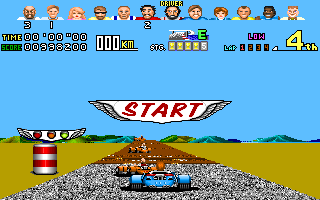
The 1990 PC version is faithful to the source material, but the arcade original absolutely crushes it graphically. On a period-appropriate PC monitor, it looked acceptable, the Sound Blaster audio was functional but forgettable. Still — at a time when Sega on home computers was far from a given, even this conversion had its kick. Today the game has aged fairly respectably within its genre: short, punchy, without modern convenience. Saving? None. Pause? Ask your parents if they can wait.
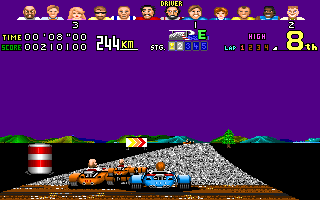
Today Power Drift suits those who want a clean quarter-hour of racing reflex training without tutorials and account-linking challenges. Fire it up in your browser via DOSBox easily, and if you lost to it in the nineties before reaching the second series of tracks, you've got your chance to set things right now. Finally, nobody's going to barge in with dinner.
 old
old


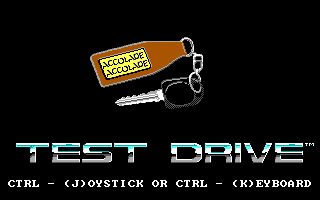 ▶Test Drive1987MS-DOS / PC


 ▶Pitstop II1984MS-DOS / PC


 ▶F11993Sega Mega Drive


