I remember that feeling when you first saw Buck Rogers: Planet of Zoom footage on a monitor in 1984 — that pseudo-3D perspective, the landscape hurtling straight at you, and you'd think: there's no way this works on a PC at home. It did. Almost.
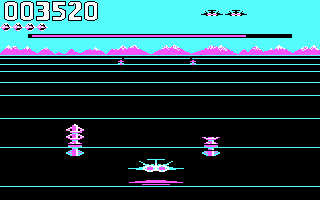
The game originally started as a Sega arcade cabinet and made its way to home computers in a port that was technically ambitious for the time. It's a shooter in third-person perspective — you fly over a planet's surface, dodge obstacles, and blast enemies. The setting is nominally futuristic, with Buck Rogers in the title fitting about as snugly as a TV perfume ad set on the Moon. No plot, no characters, no story — just speed and survival.
The mechanics are straightforward to the bone. You control the ship, you shoot, you dodge. Difficulty ramps up in classic arcade fashion — more enemies, faster pace, less room for error. The PC version manages smoother movement than you'd expect from 1984, but keyboard controls were never as precise as a joystick in the arcade. A few lives vanished just because the lag between pressing a key and the response was half a second longer than in the cabinet.
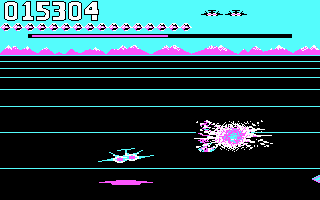
What the game brought mainly was that visual gesture — the terrain scaling effect that felt like technological magic back then. Today it's obviously just scaled sprite graphics, but in the context of 1984, it had pull. It's aged exactly as you'd expect: no story, no depth, and game sessions measured in minutes, not hours. The music on a PC speaker was exactly what it was — basically an interchangeable beeping sequence.
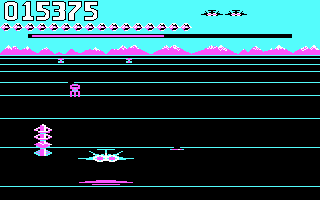
Today, Planet of Zoom is mainly played by those hunting pure arcade reflexes with no compromises — no menus, no cutscenes, no explanations. You start, you play, you die, repeat. In a browser it's a twenty-minute affair, but those twenty minutes have the right flavor of the early eighties, when every extra frame was cause for celebration.
 old
old


 ▶Doom1993MS-DOS / PC


 ▶Contra1988MS-DOS / PC


 ▶Ultimate Mortal Kombat 31996Super Nintendo