August 1991. A coup in Moscow, tanks at the White House, Gorbachev under house arrest. While the world stared at their television screens, Spectrum Holobyte had a game on the market where you could make it all happen yourself — or prevent it instead. Timing like that doesn't come around every day.
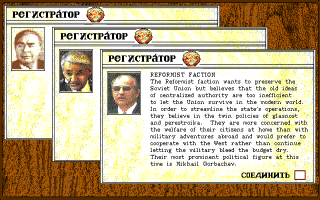
Crisis in the Kremlin from 1991 puts you in the chair of General Secretary of the CPSU. The starting year is 1985, Gorbachev's rise to power, and you must guide the Soviet Union into the new millennium. But first, you choose your ideological profile — reformer, hardline conservative, or nationalist. Each choice sets different starting parameters and a different playstyle. It's not cosmetic; it genuinely changes who forgives you and what buries you.
The core gameplay revolves around budget management and political consensus. You distribute resources between the military, agriculture, industry, consumer goods, and other sectors, monitor the mood of the population, party apparatchiks, and foreign pressure. Crisis events pop up from time to time — strikes, ethnic unrest, foreign conflicts — and you must respond. The interface is austere, tables and numbers, no graphical flash. Anyone expecting Civilization would be disappointed. Anyone coming for a political simulator got exactly that.
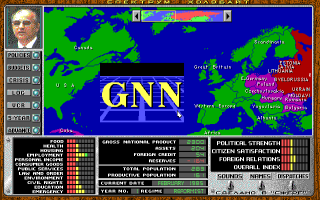
I remember the game as something unusual because it worked with real historical context at a time when that very context was literally crumbling on television screens. You could embrace glasnost and perestroika, you could bury them, you could end up in nuclear confrontation or slow economic agony. The game didn't decide for you. Today that seems obvious; in 1991 it was surprising. What hasn't aged as gracefully is the steep learning curve. Without the manual, it's easy to get lost in what each value actually means and why support just dropped in Georgia.
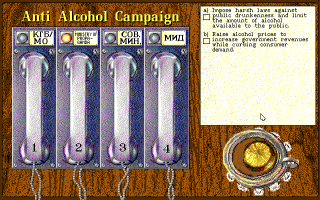
Today, Crisis in the Kremlin suits those hungry for a historical simulator with specific political grounding — not abstract strategy, but an experiment: what would happen if I did it differently. Fire it up in your browser via DOSBox without a hitch; controls are pure mouse and keyboard, so technical barriers are minimal. The only real obstacle is patience. But that was true back in 1991 as well.
 old
old


 ▶Teenage Queen1988MS-DOS / PC
 ▶North & South1990MS-DOS / PC


 ▶Sid Meier's Civilization1991MS-DOS / PC


