I mainly knew KOEI from strategy games set in feudal Japan or ancient China — Romance of the Three Kingdoms, Nobunaga's Ambition. So when this Japanese company decided in 1994 to take World War II and turn it into a turn-based command simulator, it was a bit of a surprise. And the result? Solid work, though not without its flaws.
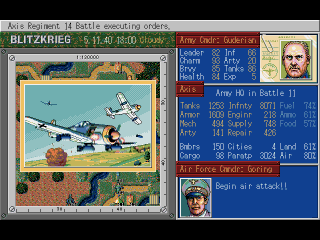
Operation Europe: Path to Victory 1939–45 is a turn-based strategy game set on the European theater of World War II. You play as either the Allies or the Axis and work through historical scenarios from the conflict's beginning to its end. Each scenario drops you into a specific situation — defensive and offensive operations, various battlefields, different conditions. The goal is always fundamentally the same: defeat the enemy on a hexagonal map, which was the genre standard at the time.
The game's core consists of two layers. On the operational map you move army units, plan supply lines, and decide where to strike. When battle occurs, the game switches to tactical combat where you command specific units directly on the battlefield. This transition works and gives gameplay the necessary depth. Terrain matters, supply lines matter — KOEI didn't simplify it into mere token-pushing. On the other hand, the AI isn't any chess champion and experienced players will quickly find its weak spots.
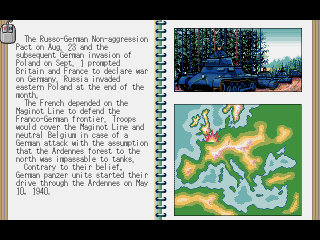
What keeps the game afloat even today is that characteristic KOEI attention to detail. The systems are well-crafted, there are enough scenarios to make replaying worthwhile, and the whole thing has a serious, almost encyclopedic feel that you rarely saw from Japanese developers of that era. What's aged the most is the interface — controls require patience and a manual at hand, because the game won't hold your hand anywhere. In 1994 such an approach was standard, today it requires dedication.
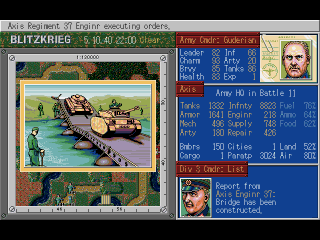
Operation Europe suits those today who have an appreciation for hexagonal war games and don't mind having to read before you play. It's not Command HQ or Steel Panthers, but it has its own logic and atmosphere. You can run it in a browser via DOSBox emulators without much trouble — and if you're even remotely curious about a Japanese perspective on the European war, it'll easily eat up a few evenings for you.
 old
old


 ▶North & South1990MS-DOS / PC


 ▶Teenage Queen1988MS-DOS / PC


 ▶Chess1998Sega Mega Drive


