Year 1989, Tetris rules the world, and every second developer is thinking: what if we complicated this whole thing? P.Z.Karen Co. Development Group answered in their own way — they added a third axis. And so Blockout was born, a game that caused me actual physical brain pain for the first time in my life.
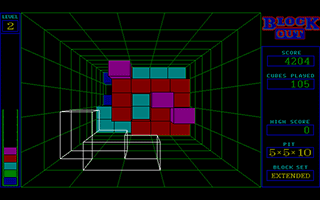
The basic idea is straightforward: Tetris, but instead of a flat surface, you're dropping three-dimensional blocks into a deep shaft. The goal is to fill entire layers — this time horizontal planes in space, not rows on the screen. Sounds simple. It isn't. Not at all.
The blocks here are true 3D solids — cubes, L-shapes, Z-shapes, various deformed forms — and you have to rotate them along three axes before they hit the bottom. You'll master the controls in five minutes, but building the spatial imagination needed to figure out in your head how a block looks from the bottom of the shaft? That takes weeks. Anyone who had only a vague grasp of geometry in school discovered in Blockout just how vague that grasp really was. As the falling speed increases, calm geometric contemplation turns into panic, where you're hammering the keys like mad and praying the block fits somewhere.

What Blockout brought in 1989 was truly unusual — a full-fledged 3D logic game on PC that required no special hardware yet looked convincing. The wireframe shaft rotated smoothly, the blocks were readable. On an EGA monitor, it was pretty solid performance. Today, the game obviously looks like a computer graphics class exercise, but the gameplay is rock-solid and hasn't aged poorly in terms of fun. What's aged less well is the complete absence of any soundtrack to pull you in — silence and the occasional Sound Blaster beep is a rather purist experience in 2024.
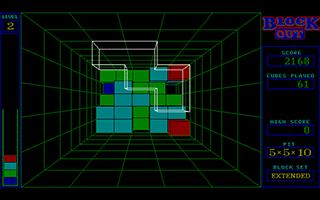
Today, Blockout suits anyone who loves logic games and doesn't want to settle for classic Tetris. It's a game for people who want to be punished for bad decisions and enjoy it at the same time. You can play it in your browser without installation or driver configuration — then you'll spend an hour trying to fill a single layer. One attempt isn't enough. Two aren't either.
 old
old

 ▶Vlak1993MS-DOS / PC
 ▶Where in the World is Carmen Sandiego1991MS-DOS / PC

 ▶Teenage Queen1988MS-DOS / PC

 ▶Supaplex1991MS-DOS / PC


 ▶Arkanoid1988MS-DOS / PC
 ▶Tetris1985MS-DOS / PC
 ▶Brix1991MS-DOS / PC
 ▶CD-Man1989MS-DOS / PC

 ▶Sokoban1984MS-DOS / PC
 ▶Amazing Maze1983MS-DOS / PC