Arcade halls in the first half of the eighties smelled of cigarettes, popcorn, and overheated electronics. And among those flickering cabinets stood Zaxxon — the one with isometric perspective that looked like a miracle back then. I first saw it in the local arcades around 1984, and my jean pocket emptied immediately.
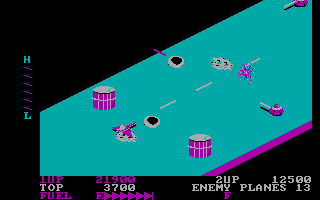
Zaxxon originally came out as a Sega arcade cabinet in 1982 and made its way to home computers gradually — the MS-DOS version ranks among the later ports. It's an air-combat shooter with isometric view where you pilot a fighter spacecraft through fortified bases full of towers, rockets, and enemy aircraft. The goal is simple: get through, survive, shoot down. The further you go, the harder it gets.
The key mechanic that set Zaxxon apart from every other scroller of that era was the altitude system. Your ship flies in three dimensions — or at least the illusion of them — and height actually matters. Too low and you'll crash into a wall, too high and you'll miss the energy barriers you have to fly through at the right altitude. Simple on paper, tricky in practice. The PC version is functional; mouse or joystick controls weren't always a given, but the keyboard was survivable — literally and figuratively.
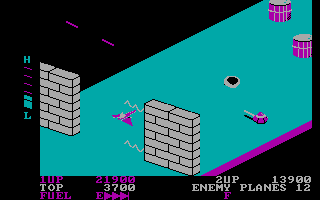
What Zaxxon brought in 1982 was revolutionary: isometric projection in a shooter, the ship's shadow on the ground as a visual guide for altitude, a sense of space in a genre where the horizon had always been a straight line. The PC port suffered from limited hardware — CGA graphics weren't exactly tear-jerking — but the principle endured. Today it's aged exactly as you'd expect. Repetitive, difficult, no saving. Three lives and restart from the beginning. Classic arcade philosophy that either entertains you or drives you crazy.
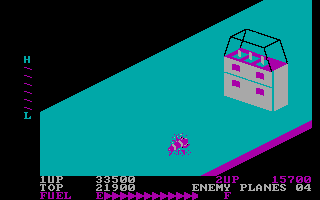
Zaxxon in the browser today will be appreciated mainly by those who remember it from the arcades and want to verify if it was as good as memory serves. It was — in context. The new generation will probably tolerate it for about ten minutes, then reach for something else. But that isometric perspective, the ship's shadow on the base floor, the series of towers you have to fly through pixel-perfectly — that was real technical achievement back then, and you can still feel it a little today.
 old
old


 ▶Doom1993MS-DOS / PC


 ▶Contra1988MS-DOS / PC

 ▶Ultimate Mortal Kombat 31996Super Nintendo
