Diese Rezension ist noch nicht übersetzt — wir zeigen das Original (English).
Year 1992, I'm sitting at a 486, and Russian folk music in MIDI arrangement is blaring from the speakers—something Tchaikovsky probably wouldn't have commented on kindly. Tetrominoes are falling on the monitor. Again. Still. Endlessly. Tetris Classic by Spectrum Holobyte isn't some knockoff — it's the official, licensed version of what Alexey Pajitnov dreamed up sometime in the mid-eighties at a Soviet research institute.
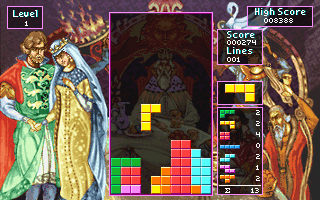
Everyone who has hands and eyes knows the rules. Seven types of pieces fall from above, you rotate and stack them into horizontal rows, rows disappear, the speed increases, the panic increases. No story, no missions, no world to save. Just you, a 10x20 field, and ever-shrinking time to think.
What set Tetris Classic apart from countless previous ports in 1992 were the game modes. Alongside classic solo play, there was a two-player mode — cooperative and competitive — which wasn't exactly standard on PC back then. Keyboard controls are precise and responsive, no mysterious lag that would rob you of a line at an awkward moment. You can adjust the difficulty yourself by choosing the starting level and the height of the pre-filled field, so you can make things harder right from the start if the base tempo feels too relaxed.
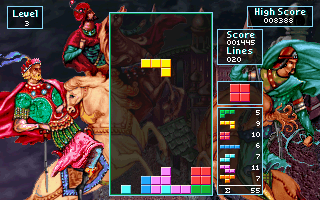
The graphics are restrained, functional, DOS-style. Nobody expected more back then. Russian motifs in the background — matryoshkas, domes, all that — nowadays feel like postcards from an era when "Soviet" aesthetic was still a curiosity in computer games, not a cliché. The music is good for about five minutes, then you turn it off. That was true then and it's true now.
What aged well: the mechanics themselves are so mathematically clean they don't age at all. What aged poorly: today's versions of Tetris have ghost pieces, hold functions, and other tricks you've gotten used to over twenty years. Nothing like that here. Pieces just fall and you either manage or you don't. Some will find it liberating, others will reach for a more modern variant after ten minutes.
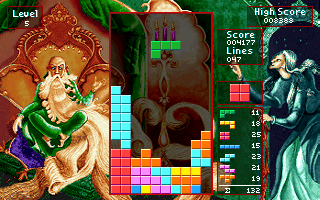
Tetris Classic in the browser today will appeal mainly to those who want to remember what the game looked like before developers added three menus, a tutorial, and online leaderboards. It's straightforward, unapologetic, and unadorned. Exactly how retro Tetris should look.
 old
old

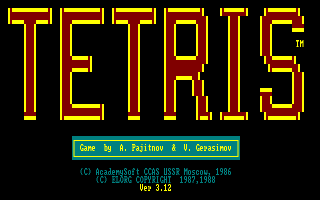 ▶Tetris1985MS-DOS / PC

 ▶Boulder Dash1984MS-DOS / PC

 ▶Sokoban1984MS-DOS / PC
 ▶Teenage Queen1988MS-DOS / PC

 ▶Supaplex1991MS-DOS / PC
 ▶Vlak1993MS-DOS / PC
 ▶Chess1998Sega Mega Drive


