Diese Rezension ist noch nicht übersetzt — wir zeigen das Original (English).
A city won't build itself. Plebs is a strategy game from 1989 that everyone with a DOS machine played if they loved city building — and simultaneously wanted to tear their hair out in frustration. Your goal is to build a thriving Roman settlement, but after your first few clicks you'll discover that the city's logistics behaves as if it were designed by a consul in an alcoholic stupor.
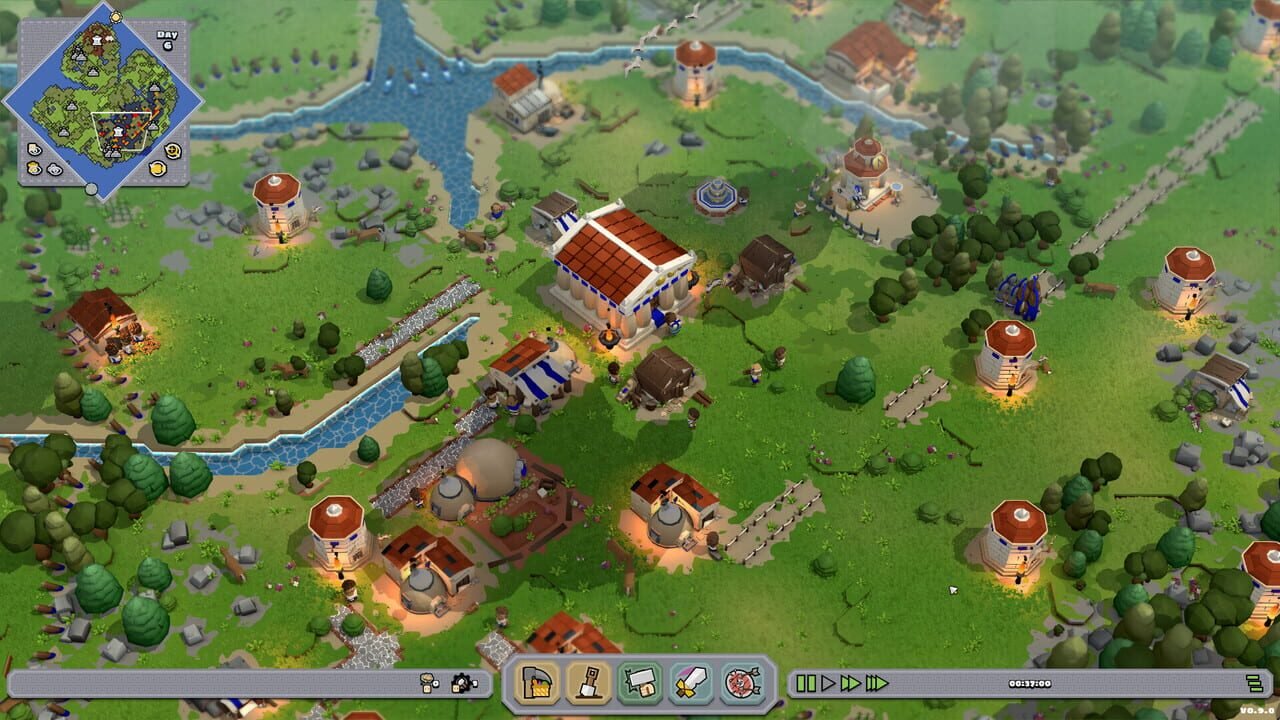
Top-down view, grid terrain, rows of menu options — that's what it looks like. You build roads, houses, temples, farms, warehouses. Every worker needs a road just to get anywhere. Food must be in storage, water must be accessible, citizens are born only when there are enough homes and happiness. Logical so far. Except when you make your first attempt to get rid of a citizen who's smoking in your city and eating all your food, you run into a beast called command sequence — and that's where it all falls apart. The controls are abysmal. Want to demolish a granary? Enter a code on the keyboard. Want to relocate a warehouse? A code. It would be simple if those numbers made sense, but they don't. You navigate the game more with a stack of papers listing keyboard shortcuts than you actually play it.
Everywhere you look, you see queues of waiting workers and depleted warehouses. Citizens go fetch water, but the path is long, so it takes forever. Meanwhile they're carrying things elsewhere. Everything is stuck. Maybe it's realistic, but it's certainly not fun. The game offers scenarios with increasingly complex objectives, but the clash between your first impression of "I like this" and the reality of playability happens almost immediately.

In the eighties, Plebs brought something new — civilization elements without warfare, a journey into ancient logistics. Today you see it as a curiosity: bound too tightly to the CLI thinking of that era, with too little regard for the fact that sometimes you just want to watch things happen. Successors like Caesar III a decade later said "why not" and Plebs remained an archive of an interesting idea that never quite took off in practice.

Play it today in a browser? Only if you're curious what city strategy looked like in an era when moving a building in a grid meant drowning in menus. DOS game collectors and curious historians will appreciate it as an artifact. Everyone else would rather play something where the interface isn't more of a challenge than the actual building.
 old
old


 ▶North & South1990MS-DOS / PC


 ▶Teenage Queen1988MS-DOS / PC


 ▶Chess1998Sega Mega Drive


