Ta recenzja nie została jeszcze przetłumaczona — pokazujemy oryginał (English).
Year 1989, Egypt, and I'm running an empire on the Nile. Sounds grand — the reality was a bit more administratively rough around the edges, but I still found myself sitting at it longer than was reasonable.
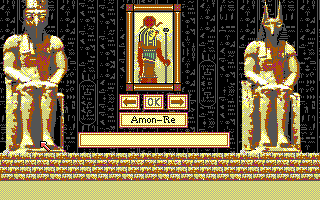
Day of the Pharaoh from French studio Chip is a management simulation set in ancient Egypt. The player takes on the role of a legitimate heir to the pharaonic throne — except the path to power isn't straightforward. You must manage the empire, keep the population content, build the economy, and simultaneously face political pressures from within and without. The genre was experiencing interesting times back then: Populous came out the same year, Civilization was still two years away, and historical simulators like this were finding their voice.
Control works through the mouse and simple menus, which wasn't a given at the turn of the '80s and '90s. The game loop revolves around resource distribution, monitoring satisfaction indicators, and making decisions that won't pay off for several turns — the classic manager's trap of that era. When your harvest starts sliding and the priests are grumbling at the same time, you've got a problem. The game won't spell it out for you twice.

What keeps Day of the Pharaoh afloat is atmosphere. The graphics are modest, but Egyptian iconography — sand, the Nile, hieroglyphic interfaces — does its job. The SoundBlaster music added a layer that today sounds like an adorable historical artifact. Where the game squeaks is in clarity: indicators overlap, feedback on your decisions is murky, and without a period manual you're sometimes left to expensive trial and error. The manual existed back then. I didn't have all of it either.
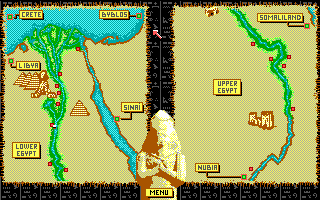
Today Day of the Pharaoh will appeal mainly to those interested in genre history — what a management simulator looked like before Bullfrog and Maxis set the bar for user comfort. As a gaming experience it's more of a curiosity than a must-play, but in your browser for fifteen minutes, knowing where and when it was made — it's worth a taste. Egypt never went out of style, its simulators just got a little old.
 old
old


 ▶Cartooners1989MS-DOS / PC


 ▶Alter Ego1986MS-DOS / PC
