Sabor is not a game you'd remember from Computer magazine covers. It's a quiet effort from 1991 that plays on screen like something between a shooter and a logic puzzle, and within a few hours it fades into oblivion. Exactly what you'd expect from a floppy disk of that era — no fanfare, no story, no reason to feel bad about forgetting it.
The game's essence is simple: you shuffle colored balls and line them up in rows. No color, no plot, no context — you're just there manipulating things on a black board. Elements bounce, fall, combine, and your brain gradually gets used to the idea that this is all the fun. It's not revolutionary, but there's a certain elegance in that minimalist core — you're not playing a story, not playing animation, not playing atmosphere. You're playing nothing but the mechanism itself.
The controls are straightforward. Cursor, mouse, or keyboard — nothing complicated. The game guides you intuitively, no tutorial, no hand-holding. I'll put it this way: it's not tedious, but it's also not the pull that grabs you by the throat and says "again!". Playing is pleasant because it's not difficult, and it's difficult because after five minutes you know what's coming in the next five.
Sabor is the type of game everyone played and nobody remembers. In some discotheque or office where DOS stuff ran during breaks — yes, maybe it was running there. But nothing that changed the gaming world. It belongs in the category of "hypothetical entertainment," which exists but only in a shrug.
Today, Sabor's relevance is purely archival. If you're interested in the DOS era as such, or you're a collector of these quiet, unambitious games, you can fire it up in an emulator. You'll find it in some older collection. But don't treat it like treasure — it's more like a marble under the table you pick up as a trivial record from when games didn't have to try at all.
 old
old


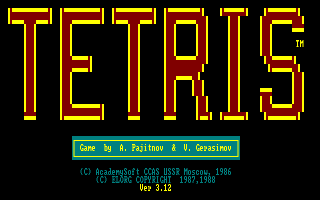 ▶Tetris1985MS-DOS / PC
 ▶Boulder Dash1984MS-DOS / PC
 ▶Teenage Queen1988MS-DOS / PC


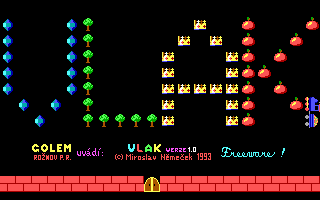 ▶Vlak1993MS-DOS / PC
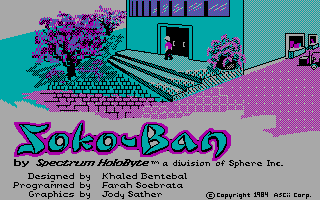 ▶Sokoban1984MS-DOS / PC
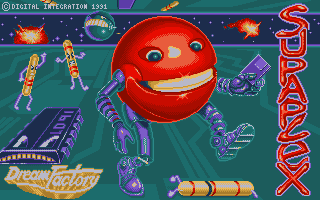 ▶Supaplex1991MS-DOS / PC
 ▶Boulder Dash III1986ZX Spectrum


 ▶Chess1998Sega Mega Drive


