Clicking on colored squares is the simplest thing in the world, until you realize the game just ended on you. Zoop is a straightforward logic puzzle from the mid-nineties that eats up your time just as easily as solitaire — yet you always feel like you should have had one more move left.

The principle is childlike: shapes in five colors tumble across the playing field and you remove them by clicking. When a block disappears, the rest shift and create new combinations. Chain reactions form — as long as same-colored pieces touch, they all vanish together. The goal is simple: clear the board for as long as you can. Don't confuse it with Minesweeper or Tetris combined — it's more like peering into a living cellular organism that reorganizes itself.
The controls couldn't be simpler. You click, you watch things shift, you click again. No trouble, no weapon selection, no pausing for strategy. The game forces you to think ahead — one wrong click means you've put a piece in an awkward spot and soon enough you're playing without any way out. There's a strange beauty to it: the logic is unforgiving, but always fair.

For the mid-nineties, Zoop was solid gaming medicine for a long afternoon. It's not a game that changes your life, but it's a game that keeps you at the screen long after you wanted to quit. The graphics are absolutely basic — colored squares, simple fonts, sounds like they came straight out of a computer museum. It aged completely naturally, because it never had ambitions to be more than what it is.

Today you play it in your browser as a flashback to when games were simple and the time to play them was long. For the modern player there's nothing surprising, but for someone who wants pure logical fun without talk of progressive challenges and monetization, Zoop still has something to offer. It's like an old greenhouse — it doesn't want showiness, it just wants patience and a willingness to think.
 old
old


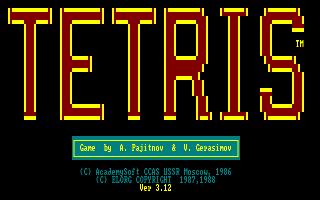 ▶Tetris1985MS-DOS / PC

 ▶Boulder Dash1984MS-DOS / PC

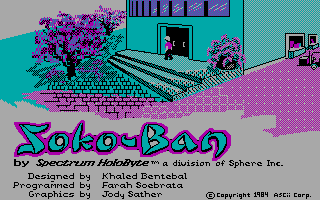 ▶Sokoban1984MS-DOS / PC
 ▶Teenage Queen1988MS-DOS / PC

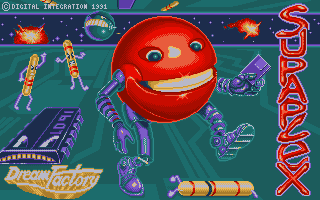 ▶Supaplex1991MS-DOS / PC
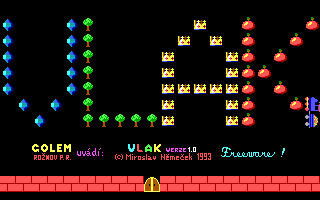 ▶Vlak1993MS-DOS / PC
 ▶Chess1998Sega Mega Drive


