Year 1994, DOS prompt blinking and I'm launching something I borrowed from a classmate on a floppy disk with no description whatsoever. A lightning-fast rabbit bursts onto the screen. Well, this is either going to be a pleasant surprise or a quarter-hour lost from my afternoon.
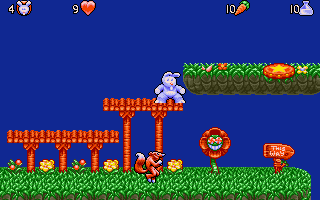
Quik the Thunder Rabbit is a platformer from French studio Stywox that doesn't hide where it draws inspiration. Take an anthropomorphic animal hero, add a fairy tale plot about saving a village, drop him into colorful worlds full of hostile creatures, and you've got a product that in 1994 on DOS tried to compete with console releases. The story setup is simple — the rabbit village is running out of carrots and Quik must find a legendary seed to restore supplies. I've seen more absurd excuses for a game adventure, but this one at least has character.
The game is split into four worlds, each with four levels. The goal in each level is straightforward: find the exit. Along the way various monsters attack you, you overcome platforms and collect what you can. The controls are straightforward, the response solid by DOS platformer standards, which notoriously suffered from the fact that a keyboard wasn't a joystick. Quik moves swiftly, which fits the name, and the game doesn't waste time on unnecessary delays. What doesn't fit as well is variety — four times four levels is rather a modest serving and the difficulty never really climbs to the point where things start getting intense.

What I remember about Quik is the visuals. By DOS standards of 1994, the sprites were colorful and readable, the environments had character. Stywox clearly knew what they were doing graphically. The music and sounds were acceptable, Sound Blaster appreciated it. The problem is that the game never reached that level of addictiveness that made Jazz Jackrabbit or Crystal Caves titles you'd forget to have dinner over. Quik is honest mediocrity — no disaster, but nothing that would make you talk about it the next day at school either.
Play it today if you're curious what the second tier of DOS platformers looked like in the nineties. As a historical document it's interesting — a studio without a big budget attempted a genre that was always somewhat lagging behind consoles on PC. An hour, maybe two, and you're done. I've definitely seen worse ways to spend an afternoon in the oldgame.cz archive.
 old
old


 ▶Doom1993MS-DOS / PC


 ▶Contra1988MS-DOS / PC


 ▶Ultimate Mortal Kombat 31996Super Nintendo

