Three seconds after you start Capone, a guy in a fedora walks across the screen and you shoot him. That's the entire pitch. Actionware didn't waste anyone's time with setup.
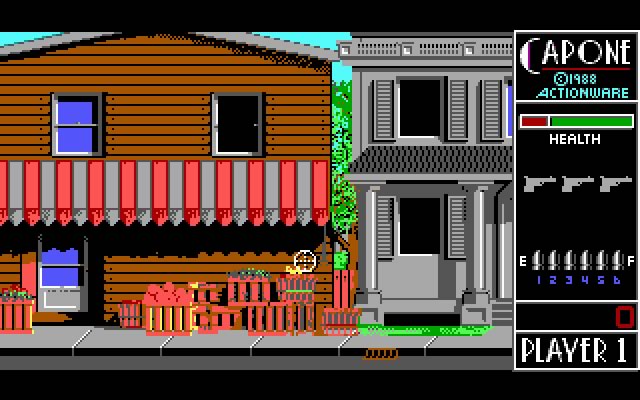
Released in 1988 for MS-DOS, Capone drops you into a fixed-perspective, prohibition-era Chicago street scene where the only agenda is lead. You're a gangster — the gangster, presumably — and waves of rivals, cops, and assorted hat-wearing obstacles come at you from every direction. The backdrop is all brownstones and parked Model Ts, the color palette ranges from "grim" to "grimmer," and the atmosphere is about as subtle as a tommy gun through a speakeasy window. There's no story to follow. The game trusts you to fill in the narrative yourself, which in 1988 meant you just pretended you were settling scores on behalf of someone named Sal.
The gameplay is a light-gun-style shooter without the light gun. You move a crosshair, you shoot things, you try not to get shot. Civilians wander into the line of fire — hit one and you lose points or a life, I forget which, and honestly it didn't matter much because the penalty never felt steep enough to change your habits. The difficulty climbs through repetition rather than invention: more enemies, faster pacing, same street. It's the kind of design that works in an arcade cabinet for forty seconds and stretches awkwardly across a home session. A keyboard and no mouse made the aiming feel like steering a shopping cart with a wobbly wheel.
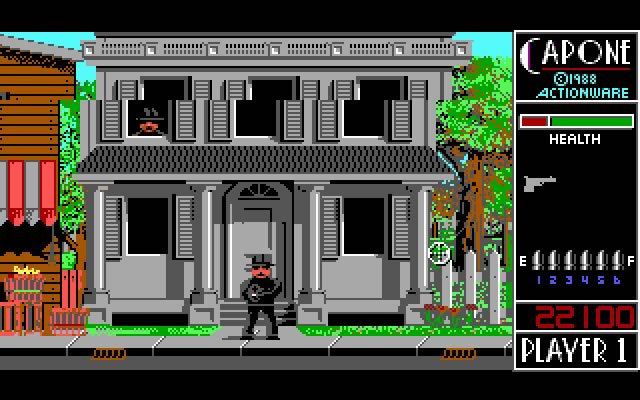
What Capone actually delivered in 1988 was atmosphere at a price you could afford. On a Hercules monochrome monitor the high-contrast sprites had a certain dirty newspaper quality that suited the 1920s setting better than it had any right to. The Sound Blaster — if you had one, and most people didn't yet — pushed out gunfire and footsteps that made the whole thing feel momentarily cinematic. That moment passed quickly, but it was real. The game leaned hard on the Scarface-era gangster mythology that was everywhere in the late eighties, and for a twelve-year-old that framing was more than enough to keep you at the keyboard for an afternoon.

It aged the way most single-mechanic arcade ports aged: fine as a curiosity, thin as an experience. There's no depth waiting underneath once the novelty wears off. Playing it today in a browser, you'll get the gist inside ten minutes and feel no particular urge to continue. But if you want a clean, honest snapshot of what a budget PC action game looked and felt like in 1988 — the limitations, the charm, the complete absence of hand-holding — Capone delivers exactly that. Sometimes a game's value is just being a reliable witness to its own moment in time.
 old

 Factory sealed originalTHE Crime Files Cd-rom - Rare - Capone - Dahmer - Dillinger - Mpeg NEW SealedView on eBay »


 ▶Bubble Bobble1989MS-DOS / PC


