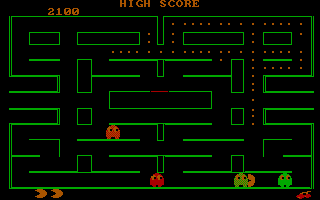
Pac-Man needs little introduction: Namco's 1980 arcade phenomenon became one of the most recognisable video games ever made, and this MS-DOS release from Atarisoft brought the maze-chase to home PCs. The concept is pure and perfect. You guide Pac-Man around a walled maze, gobbling every dot while four ghosts, Blinky, Pinky, Inky and Clyde, hunt you down. Eat one of the four large power pellets and the tables turn briefly, letting you chase and eat the ghosts for bonus points before they recover.

The genius of the original lies in the ghosts' distinct personalities and the rhythm of risk and reward as you clear a board, dodging just close enough to snatch the fruit bonuses. The Atarisoft PC conversion is a straightforward port aimed at getting that arcade loop running on early IBM-compatible hardware, so the look and sound are simpler than the coin-op, and how faithfully it plays depends a lot on the machine and graphics mode of the day.
As a game to actually sit down with, the core design is timeless. Pac-Man is easy to grasp and genuinely hard to master, with pattern-learning and nerve deciding how far you get. This home version is more a historical curiosity than the definitive way to play, but it captures the essential appeal that made the little yellow character a global icon.
Pac-Man is recognised by people who have never played another game. Which is exactly why it gets discussed superficially: most people think of it as a game about running from ghosts, and that is a misreading. Pac-Man is a game about patterns, and about the fact that its four pursuers each behave differently.
That is its real contribution and the reason it still appears in game design courses. If the ghosts all chased identically, this would be a reflex game. Because they behave differently, it becomes a game about reading a situation.
How it plays
Eat every dot in the maze without getting caught. Four large dots sit in the corners, and eating one turns the ghosts into prey for a short while. That is the only weapon in the game and budgeting it is the central strategy.
The ghosts have distinct behaviours. One pursues you directly, one tries to get ahead of you, one moves unpredictably, and the last behaves differently up close than at a distance. The practical consequence: no single trick beats all of them, because each responds to a different input.

Working the side tunnels is essential. Crossing to the other side gets you out of a trap, and ghosts move more slowly inside, which makes it the most reliable escape route. Players who learn to navigate around the tunnels survive far longer.
The large dots should not be eaten on sight. The best play is to wait until the ghosts cluster nearby and only then take one — eating four ghosts in a row is the biggest scoring opportunity in the game. Eating a power dot the moment you see it throws most of your score away.
As the game progresses the ghosts speed up and the vulnerable window shortens until it disappears entirely. So there is no ending in the sense of winning; there is a point at which the game becomes unsustainable.
What aged well and what did not
The design aged brilliantly. Ghost behaviour is still cited as the model example of building an interesting opponent out of simple rules. Clarity aged well too — one screen, no off-camera surprises, rules obvious at a glance.
Repetition aged badly. The maze never changes and the only progression is rising speed. Keyboard control aged badly as well; turning in tight corridors is less precise than it should be, and the difference against the original joystick is noticeable.
Where to start
Do not rush the dots. Track a single ghost and watch how it responds to your movement — once you understand one, the others become easier to read. Save the power dots and use the tunnels.
From the same era the catalogue has Donkey Kong as the other pillar of arcade classicism and Arkanoid for a different kind of precision. To see the same idea reworked for home computers, there is CD-Man.
 old
old


 ▶Tetris1985MS-DOS / PC

 ▶Boulder Dash1984MS-DOS / PC

 ▶Teenage Queen1988MS-DOS / PC
 ▶Sokoban1984MS-DOS / PC
 ▶Supaplex1991MS-DOS / PC
 ▶Vlak1993MS-DOS / PC
 ▶Chess1998Sega Mega Drive


