Year 1986, I'm sitting at my dad's office where a PC XT stands, trying to figure out why that enormous tank on the screen can't be stopped by anything I have at my disposal. Ogre from ORIGIN Systems was a mystery back then — and looking back, I'm fine with that.
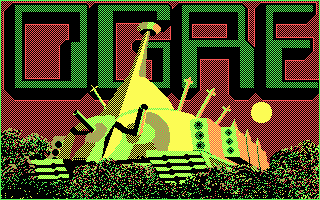
Ogre is a turn-based strategy game, not a platformer, regardless of what the catalog says. It's based on Steve Jackson's board game from 1977 and brings its rules to the screen with a resolution that wouldn't turn heads even on a calculator today. The setting is near future, war, and you command conventional units — infantry, tanks, artillery — whose only job is to stop one target: a giant cybernetic tank called Ogre. It thinks for itself, has more firepower than your entire division, and won't stop until it reaches the command center.
The mechanics are asymmetrical and that's the whole point. You have numerical superiority, Ogre has superiority in everything else. Each turn you decide which units to sacrifice as a delaying tactic, where to direct your fire, and what can still hold out a bit longer. The game gives you a hex grid, clear statistics, and rules you can understand in fifteen minutes. Learning to master them takes longer.
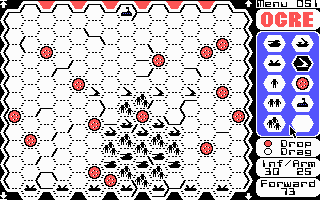
What Ogre brought was a faithful conversion of a board game into computer form at a time when other developers were still debating whether it was even possible. The interface is spartan, the graphics are what was called functional back then, and sound — well, there basically wasn't any. Yet the game works because the rules are solid and the tension of every turn is real. What's aged poorly? Visually it's an artifact, no amount of nostalgia can sugar-coat that. And if you never played the original board game, you might be puzzled about why this should entertain you at all.
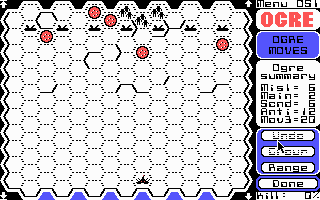
Today Ogre appeals to someone who remembers that strategy doesn't need animations or base building — a solid system and one proper problem to solve will do. Try it in your browser without installation, and after twenty minutes you'll know if it's grabbed you. Either yes, or no. Ogre doesn't worry about it.
 old
old
 ▶Prehistorik 21993MS-DOS / PC


 ▶Hugo 31995MS-DOS / PC
 ▶Dangerous Dave in the Haunted Mansion1991MS-DOS / PC


 ▶Toy Story1995Sega Mega Drive

 ▶Commander Keen 4: Secret of the Oracle1991MS-DOS / PC
 ▶Contra1988MS-DOS / PC

 ▶Giana Sisters1987MS-DOS / PC
