Year 1992, Sierra On-Line — the company that had given me Quest and Larry up to that point — released a game where you don't play as an adventurer, detective, or astronaut. You play as a person trying to survive. Pay rent. Find a job. Maybe eat more than one serving of food a day. As a life simulation, it sounds boring. As a game, it sounds weird. And yet Jones in the Fast Lane worked better in 1992 than it had any right to.
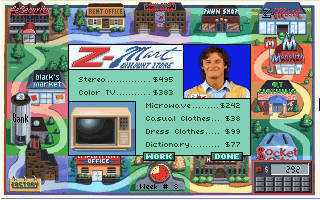
It's a life simulator — a genre that practically didn't exist back then. You start from zero: no education, no job, a miserable apartment, and an empty wallet. You set your own goals, because the game presents you with four values — happiness, education, employment, and money — and you decide what you want to achieve and to what extent. Want to be rich? Educated? Or just content? Everyone plays a different version of the same city.
The playing field is a schematic city — you move between screens with shops, schools, employment offices, apartments, and restaurants. Every move costs time, every action costs time or money or both. The mechanics are turn-based in the sense that each round equals one week, so every decision carries weight. Take a better job, or improve your education first? Save up for a better apartment, or eat today? The game forces you to think ahead, and that's surprisingly compelling. You can also play with two players, which in those days was a solid reason to stick around one computer longer than was healthy.
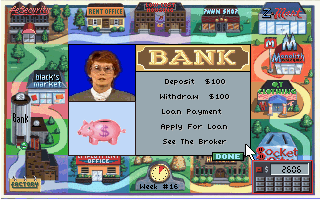
What aged well: the core decision loop still holds. The tension between short-term and long-term strategy is real, and the game genuinely punishes you for bad decisions. What aged poorly: the graphics were schematic even for 1992, and the pace can be frustrating if you're waiting for something to happen on its own. It won't. Jones doesn't carry you — you carry it.
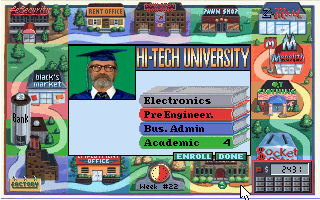
Today it'll appeal mainly to those who love games where the outcome depends on planning, not reflexes. It's actually closer to strategy than platformer, regardless of what genre anyone assigns it. If you ever enjoyed Capitalism, early The Sims, or just the philosophical question of why my game money always ran out on Wednesdays in 1993 — Jones in the Fast Lane is worth an hour in your browser. You might find you have more appetite for simulating adulthood than you'd expect.
 old
old
 ▶Prehistorik 21993MS-DOS / PCPrince of Persia▶Prince of Persia1990MS-DOS / PC


 ▶Contra1988MS-DOS / PC
 ▶Commander Keen 4: Secret of the Oracle1991MS-DOS / PC


 ▶Toy Story1995Sega Mega Drive
 ▶Dangerous Dave in the Haunted Mansion1991MS-DOS / PC


 ▶Giana Sisters1987MS-DOS / PC