Year 1993, I'm twelve years old, and I'm staring at Fatty Bear's Birthday Surprise in a store with my jaw hanging open — not because I want to play it, but because my seven-year-old cousin does. Back then, the game seemed way too cute to me. Now, thirty years later, I have to admit she was right.
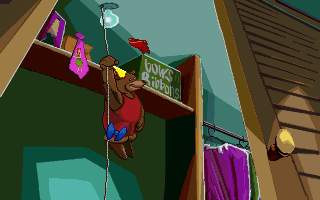
Humongous Entertainment, the studio of Ron Gilbert and Shelton Shea, specialized in adventures for the youngest players at that time. Fatty Bear's Birthday Surprise from 1993 is one of their early efforts — a point-and-click adventure where the bear Fatty Bear secretly prepares a birthday cake and a gift for a little girl named Kayla while the whole house sleeps. No villain, no timer, no pressure. Just peaceful exploration of a house at night.
The controls are intentionally simple: one mouse button, no inventories full of mysterious objects, no death. A child clicks, something happens, the child laughs. The scenes are short, rewards immediate. The graphics are drawn, warm, in the spirit of Saturday morning cartoons — and for DOS standards in 1993, they look surprisingly good. The voices are clear, the music unobtrusive but pleasant. Nothing here gets on anyone's nerves, adult or otherwise.

What Fatty Bear brought was rare at the time: a game truly designed for children aged four to eight, not just a simplified version of a game for adults. No violence, no frustration, no moment when a parent has to step in to unlock progress. Humongous took this approach to its logical conclusion and then repeated it with Putt-Putt, Freddi Fish, or Backyard Sports — but Fatty Bear was one of the first attempts. Today the game has aged gracefully. It's short, it's simple, and an adult can beat it in an hour.
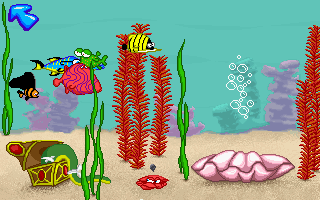
Who will enjoy it today? Parents who want to sit a preschooler down at a computer without worrying about content. Nostalgics who played it as kids and want to relive that feeling. And maybe even those who want to be reminded of what game design looked like when it made no compromises — it simply took its target audience seriously and worked for them, not despite them.
 old


 ▶Bubble Bobble1989MS-DOS / PC


