Diese Rezension ist noch nicht übersetzt — wir zeigen das Original (English).
The Learning Company didn't release games in 1992 that tried to hide what they were. The title says it all: you travel through time, you're in American history, and you're supposed to learn something. No illusions, no marketing wrapping. This honesty was refreshing and somehow a bit condemning at the same time.
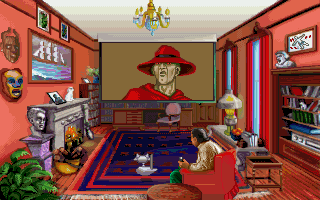
Time Riders in American History is an edutainment title for MS-DOS focused on American history. The player travels through various historical periods, solves quiz tasks, and gathers information. The goal is clear: wrap education into an interactive form so that a kid sitting at the monitor doesn't bail after five minutes to go kick a ball in the yard. Whether it succeeded depends a lot on the age and patience of the particular child.
Gameplay is built on logical puzzles and knowledge questions. The mechanics are simple, controls pose no challenge — though that was never really the point anyway. The point was for the kid not to get stuck on controls and to focus on the content instead. From a gaming perspective, it's more of an interactive textbook than a game in the classical sense. Anyone missing an action element was probably disappointed. Anyone satisfied with walking through a historical scene and answering a question correctly was happy.
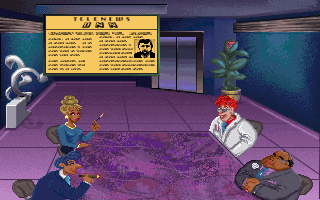
The Learning Company had a clear place in this genre. Their products — and this one is no exception — were solidly crafted, pedagogically well-thought-out, and visually acceptable for their time. Today the game has aged exactly as expected: the artwork is modest, the pace slow, and the content exclusively focused on American history, which has always been and will remain a slight barrier for non-American audiences. If you're not American and US history doesn't ring any bells for you, you'll feel a bit like a tourist at an exhibition where all the labels are written for the locals.
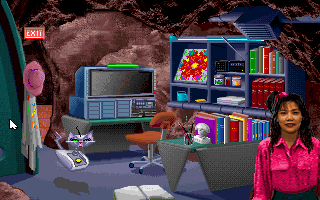
Nowadays, two groups of people will probably play Time Riders in a browser: nostalgic folks who stumbled upon it in school sometime around 1993, and edutainment genre enthusiasts mapping out what educational games looked like back then. For both groups it makes sense — not as a source of entertainment, but as a period document about how computer-based learning was done back then. And that's actually quite an honest legacy.
 old
old


 ▶Tetris1985MS-DOS / PC
 ▶Boulder Dash1984MS-DOS / PC


 ▶Teenage Queen1988MS-DOS / PC
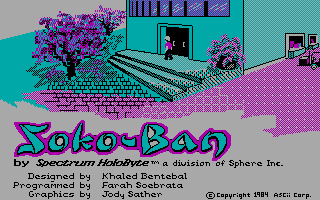 ▶Sokoban1984MS-DOS / PC
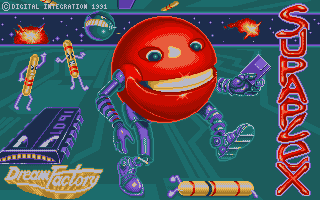 ▶Supaplex1991MS-DOS / PC
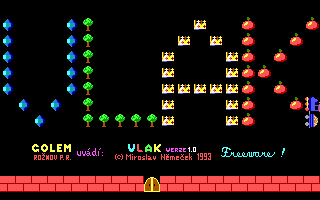 ▶Vlak1993MS-DOS / PC
 ▶Chess1998Sega Mega Drive


