Ta recenzja nie została jeszcze przetłumaczona — pokazujemy oryginał (English).
1991, Thursday afternoon, and I'm sitting at the monitor with a printout of historical data from my dot matrix printer. To catch a thief. In a computer game. My parents saw it as education, I saw it as a detective story — and we were both right.
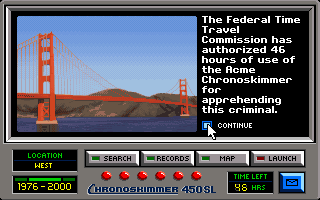
Where in America's Past is Carmen Sandiego is part of Brøderbund's legendary series that convinced thousands of kids in the eighties and nineties that geography and history were actually cool. This time, American history is the target — instead of traveling across continents, you journey through time across the history of the United States. Carmen's gang steals historically significant objects, and your job is to track down the perpetrator, build a profile based on witness descriptions, and bring them to justice.
The gameplay runs on the series' tried-and-true formula: you gather clues, build a portrait of the suspect from witness accounts, and issue a warrant at just the right moment. Too early and the court sends you home, too late and the thief disappears. The game doesn't push you with force — it pushes you with uncertainty. And that's so much worse. The controls are mouse-based, the environment shown through static images, the pace slow as was customary back then. Anyone expecting action was barking up the wrong tree.
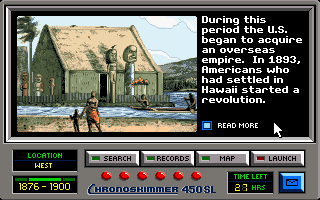
What sets this part of the series apart is precisely that historical dimension. It's not enough to know where a city is — you need to know when things happened, which era matches which clue. So the game functions as a subtle lesson in American history, and better than many a textbook, because the motivation is clear: I want to catch this guy. The educational content isn't an excuse here, it's the engine driving everything. That was exceptional then, it's almost touching now.
What aged less gracefully is the pace and the lack of any feedback for players unfamiliar with American history. A European kid in the nineties struggled. A lot. The game assumes a certain baseline knowledge of context, without which the clues become random guessing. The graphics are period-appropriate and not particularly stunning even by the standards of the day — functional, nothing more.

Today, it plays best for those who have a connection to the Carmen Sandiego series or simply want to taste what educational games looked like in an era when developers still believed players could be made to think. It runs flawlessly in a browser via emulator, and an hour with it is a pleasant trip back to a time when your desk had a dictionary and notebook instead of Wikipedia. That warrant won't fill itself out.
 old
old

 ▶Tetris1985MS-DOS / PC
 ▶Boulder Dash1984MS-DOS / PC

 ▶Teenage Queen1988MS-DOS / PC
 ▶Sokoban1984MS-DOS / PC

 ▶Supaplex1991MS-DOS / PC
 ▶Vlak1993MS-DOS / PC
 ▶Chess1998Sega Mega Drive


