Ta recenzja nie została jeszcze przetłumaczona — pokazujemy oryginał (English).
When the nineties heard the word strategy, it often meant either Dune II or some map-and-units thing played in real time. Gettysburg from 1993 goes a different route — it's a turn-based strategy with ambition to simulate an actual Civil War battle, not an arcade clash.
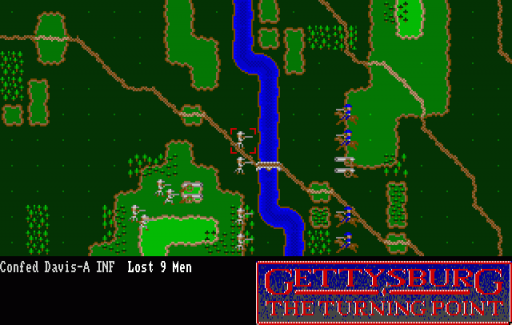
You play solo. Command either the North or the South. You get a map with all units positioned where they stood July 1–3, 1862, and must defeat the enemy or achieve historical objectives — hold the hill, maintain the line, decide the battle. Units are represented by icons, each with morale and combat readiness ratings. Turns are limited, which hammers home the historical fragility of positions.
The mechanics are straightforward, almost bland. Select a unit, set direction of movement, watch bonuses and losses add up — terrain, formation, possible support. Battles are calculated abstractly. There's no drama like later turn-based strategies deliver, but that's also the point — no animated fanfare, just numbers and logic. The game doesn't entertain you; it convinces you.
From today's perspective, Gettysburg is meat without sauce. Graphics match the era — low resolution, monochrome units, text windows. No stories, cinematics, or soundtrack to quicken your pulse. It's pure strategy, like an old-school wargame, just computerized.
Still, it's craftsmanship. The game doesn't show you the way, offers no tooltips. You have to read the manual, understand the historical context, then commit to a turn. You can't win through brute force — you have to think. It's for people unbothered by abstraction and who love history more than window dressing.

Play it today if you want to see the roots of PC strategy outside sci-fi and fantasy. Not entertainment gaming, it's a thinking gymnasium. And frankly — that's worth it.
 old
old


 ▶North & South1990MS-DOS / PC
 ▶Teenage Queen1988MS-DOS / PC


 ▶Chess1998Sega Mega Drive


