Year 2000, I've got the millennium bug behind me, and someone drops a fan-made remix of an old fighting game with anthropomorphic animals onto my disk. That's the last thing I expected back then.
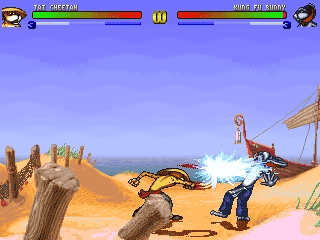
Brutal: Paws of Fury was originally released in the mid-nineties as an explicit answer to Mortal Kombat — except instead of human fighters, you've got animals tearing it up. A kangaroo, a wolf, a tiger, a panda. The setting looks like a children's cartoon, but the game wasn't pulling any punches. Sometime around 2000, a fan going by the name Doctor M took the original foundation and released a remixed PC version — with revamped graphics, reworked mechanics, and actually running on the Windows of that era. The result is a fun oddity sitting somewhere between the original and a fan project.
Gameplay stands on the classic fighting game formula of the time: pick a character, fight through a series of opponents, and eventually face off against the final boss — a guru-type who runs some kind of fighting school that you're climbing through. The controls work exactly as you'd expect from an MK clone: basic combos, special moves, blocking. Nothing revolutionary, but solidly tested. The difficulty is reasonably balanced — not trivial, not unfair either. Each character plays a bit differently, so there's a reason to try more than one fighter.
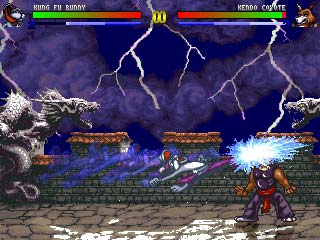
What keeps this game's head above water even today is the animal aesthetic. Where MK went for gore and blood, Brutal bet on humor and absurdity — and that's aged surprisingly well. The animations have charm, the fighters are distinct and quirky. What hasn't aged as well is the depth: strategy doesn't really trump reflexes here, and the move repertoire is pretty limited compared to later fighting games. The remixed version adds polish, but doesn't fundamentally expand the foundation.
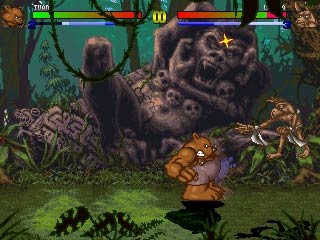
These days anyone with a browser can play it if they dig fighting games from the 16-bit console era and don't mind that the bouts lack the depth of Soul Calibur. For nostalgics who gorged themselves on every MK clone in the nineties, it's a pleasant afternoon. For everyone else, it's at least a fascinating testament to the fact that fans in 2000 could deliver a functional product — and out of pure love for it, not for a paycheck.
 old

 Vintage Retro Wolfenstein Men's T Shirt Assorted ColorsView on eBay »
 Wolfenstein Order Panzerhund Figure Loot Crate ExclusiveView on eBay »


 ▶Bubble Bobble1989MS-DOS / PC


 ▶Ghosts N Goblins1987MS-DOS / PC


