Ta recenzja nie została jeszcze przetłumaczona — pokazujemy oryginał (English).
I read MAD Magazine through a friend whose older brother kept it hidden under his mattress. The white spy, the black spy, traps, keys, and absolute distrust — that was the foundation of Prohla and Berg's comic strip. The Spy vs Spy series brought it to the screen, and Arctic Antics from 1988 was the third and final installment of this brawl.
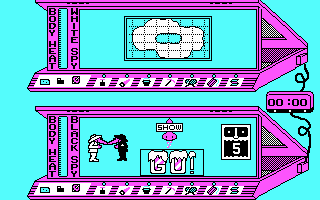
Both spies relocated to an arctic setting, away from the exotic islands and city streets of the previous installments. The goal remained the same as always: sabotage your opponent, survive, win. The core DNA of the series — two players, one monitor, mutual treachery — hadn't changed. A single-player mode was present, but who had the heart to mess with the computer.
The game is action-oriented in a very loose sense of the word. You move around a split screen, collect items, set traps, and try to make your opponent's life as difficult as possible. The controls on PC were straightforward for the time, though not entirely elegant — a keyboard was never ideal for action reactions. The arctic setting added new elements and visual variation, but the core mechanics were identical to the previous installments. Veterans of the series found no surprises, newcomers had a decent entry point.
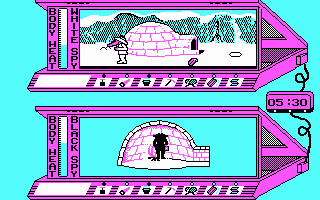
The third installment arrived when the series was beginning to run out of steam. A fourth installment was announced — Spies in Space — which never came out, and Arctic Antics thus became an unwitting farewell. That gives it a certain melancholy today, which nobody suspected when playing it in '89. We remember the series mainly because two players on one keyboard is a concept that carries natural tension within it — and that works regardless of platform or year of release. What hasn't aged as well is the simplicity of the design itself. Looking at the game today, it's clear that more demanding alternatives existed in parallel in the genre.
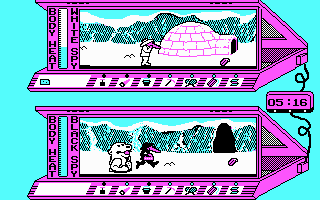
Today Arctic Antics will mainly appeal to series fans or MAD Magazine enthusiasts who want to see the trilogy through to the end. And then to people who have a friend willing to share a keyboard — that's still the best configuration for this. It can be launched in a browser via DOSBox without much fuss, and twenty minutes with it as a memento of the split-screen era before that term even existed is time well spent.
 old
old


 ▶Doom1993MS-DOS / PC


 ▶Ultimate Mortal Kombat 31996Super Nintendo

