Ta recenzja nie została jeszcze przetłumaczona — pokazujemy oryginał (English).
Electronic Arts in 1993 wasn't just a company fighting for shelf space with adult action games. It also had a division for the youngest players, and Scooter's Magic Castle is exactly the type of title you'd buy for your four-year-old sibling back then — and then end up watching it yourself because you mysteriously felt like clicking around too.
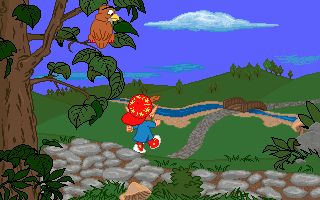
The game is an educational title for preschool and early school age. The player explores a large magic castle full of rooms, where various puzzles and minigames await, designed to develop spatial thinking, logic, and basic skills. Scooter, the game's cute mascot, guides you through the corridors and opens doors to further adventures. The fairy-tale castle setting made perfect sense: each room could be a different world, a different type of task.
The controls are intentionally simple — mouse and minimal inputs, so even a kid who mixes up left and right can handle it. The puzzles are graduated, so the game grows with the child for at least a while. What I remember as typical for EA titles of that era is solid graphics at EGA or VGA resolution and sound effects that were at least functional on a Sound Blaster. The room contents revolve around visual and spatial tasks — assembling, matching, sorting. Nothing that demands reading or writing skills, so language barrier isn't an issue for the youngest players.
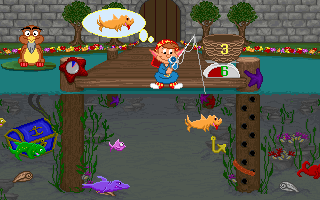
Today it's a curiosity. Educational games from that era have a peculiar charm — they're slower, gentler than today's apps that flash at kids every second. Scooter's Magic Castle hasn't aged poorly in the sense of being broken or unusable, but the content is necessarily limited. A thirty-year-old won't last more than five minutes with it. A five-year-old — maybe half an afternoon, and that's precisely the target audience it was designed for.

These days anyone can play it in a browser through DOSBox emulators and similar archives. It mainly makes sense as a window into how EA thought about the children's segment in the early nineties — before it became completely consumed by sports franchises and shooting games. If you have a small child at home and want to show them what a computer looked like when you were small, this is a gentle and non-aggressive entry point. For you personally, it'll mostly be a hit of nostalgia — probably two minutes long.
 old
old


 ▶Tetris1985MS-DOS / PC
 ▶Boulder Dash1984MS-DOS / PC

 ▶Sokoban1984MS-DOS / PC
 ▶Teenage Queen1988MS-DOS / PC
 ▶Vlak1993MS-DOS / PC


 ▶Chess1998Sega Mega Drive


 ▶Supaplex1991MS-DOS / PC
