Esta reseña aún no está traducida — mostramos el original (English).
Year 1990, a CGA monitor glows yellow in a dark room and that signature beeping melody streams from the speakers — the kind that either pumped you up or brought your parents asking you to turn it down. Super Solvers: OutNumbered! wasn't a game you'd remember because it blew your mind. You remembered it because it forced you to do math — and you barely realized you were learning while doing it.
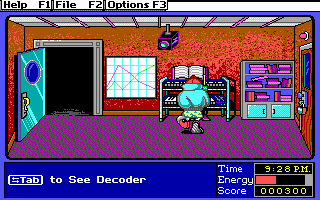
The Learning Company knew what it was doing. Educational games back then had a reputation for being boring textbook exercises plastered onto a screen, but the Super Solvers series at least tried to wrap learning in a story. This time it's about television — the villain Mortimer has taken over a TV station and you, the player, have to break in, gather clues, and stop his plans. A plot as basic as Saturday morning cartoons, but in 1990, that was enough.
The game combines station exploration with math tasks — addition, subtraction, multiplication, division, all scaled to difficulty levels you set yourself. You move through building floors, open doors, dodge Mortimer's henchmen, and solve problems to progress. The mechanics are simple to the point of being schematic. No deep adventure logic, no puzzles requiring lateral thinking — at its core it's drilling basic arithmetic with an action veneer.
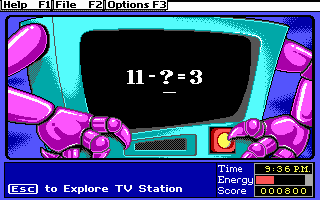
If you played Midnight Rescue back then, you'll get serious déjà vu. OutNumbered! shares nearly identical structure with its predecessor — different setting, slightly refreshed graphics, different subject matter. The Learning Company recycled the working formula for math with the same enthusiasm modern developers churn out yearly sports titles. But honestly — for what it offered, it worked. Difficulty levels made sense, the game could be tweaked for different age groups, and the learning wasn't just window dressing — it was the actual backbone of play.
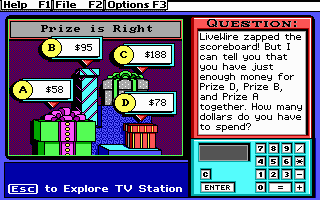
Today OutNumbered! has aged exactly as you'd expect. Graphics are modest even by 1990 standards, the sound design is best left unheard through headphones, and the game loop repeats quickly. For an adult player there's more nostalgia than fun here. But as a window into how educational software was approached back then, it has its value — no sarcasm intended. Today it's best played by someone who remembers it from the school computer lab, or a parent curious about what edutainment looked like before tablets and apps started nagging you with notifications for every correct answer.
 old
old


 ▶Amazing Spider-Man1989MS-DOS / PC


