 old
old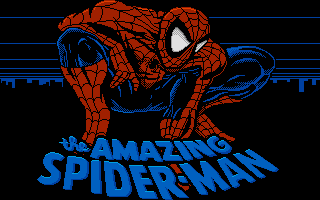 ▶Amazing Spider-Man1989MS-DOS / PC


 info onlySpider-Man 3: Invasion of the Spider-Slayers1993Game Boy / Color
 info onlyWolverine: Adamantium Rage1994Super Nintendo


 info onlyBlade2000Game Boy / Color
 info onlySpider-Man 2: The Sinister Six2001Game Boy / Color
 info onlyDaredevil2003Game Boy Advance
 info onlyUltimate Spider-Man2005Game Boy Advance


The earliest Marvel games threw no punches at all. Scott Adams' Questprobe line was a set of text adventures built on inventory and logic, and Questprobe Featuring The Hulk makes a puzzle out of the character himself: the Hulk can smash almost anything, so the difficulty lies in working out what to smash and when it pays to turn back into Banner.
Fighting arrived later, first as a straight duel. The Amazing Spider-Man and Captain America in Dr. Doom's Revenge! puts two characters face to face and breaks between rounds for comic panels that carry the story forward. Around the same current, the licence travelled hero by hero — Hulk, Daredevil, Blade, Wolverine — with each one handed whatever genre happened to be in fashion.
The main line belongs to Capcom's CPS-2 board and escalates in visible steps. It opens with X-Men: Children of the Atom, then Marvel Super Heroes hands out Infinity Gems as stones you switch on mid-match for a temporary edge. X-Men vs. Street Fighter introduced teams of two with tagging in the middle of a combination, Marvel Super Heroes vs. Street Fighter widened the roster around that idea, and Marvel vs. Capcom: Clash of Super Heroes added assist characters who dash in on a single button.
What runs in the browser
The line ends at teams of three drawn from an enormous cast in Marvel vs. Capcom 2: New Age of Heroes. Five titles from this group start here: Marvel Super Heroes, X-Men vs. Street Fighter, Marvel Super Heroes vs. Street Fighter, Marvel vs. Capcom and the duel in Dr. Doom's Revenge. The Questprobe adventure and Marvel vs. Capcom 2 are catalogued as profiles to read rather than games to launch.