Four rows, four columns, numbers that add up. It sounds simple, but then you realize that every move might be your last. 2048 on DOS from 2019 is number logic in its purest form — no animations, no graphics, just green text on a black background and your brain against your own greedy strategy.

It's about moving numbered tiles — you control them with the cursor, up, down, left, right. When two identical numbers meet, they combine into one. Two plus two is four, four plus four is eight, and so on, until you create a tile with the number 2048. Simple rule, but the game isn't about reaching the goal — it's about how long you can keep creating new numbers without the board getting completely jammed.
What makes playing fascinating is the pressure. Every time you move, a new small tile appears in a random spot. There's no time limit, but psychologically you feel squeezed — you know the end is approaching. Decision-making isn't complicated, but its consequences are. In the DOS version without windows and icons, you'll notice every move more clearly. The purity of this port doesn't weaken it — it actually highlights it.

2048 was never a game for retro enthusiasts, more for time travelers. At the end of the nineties everyone played it on their phones, and then it vanished. The DOS port from 2019 is a curiosity without sentiment — it's not a mandatory memory, but a sentence back in time to verify whether that game was really just on paper in your head or if it was an actual phenomenon.

Today it's worth playing if you want minimalist logical gameplay without unnecessary fluff. No sounds, no story, no reason — just a number puzzle that won't let you sleep. You can easily run it in a browser and you're done in no time. It's not a game that will get you on your knees, but simplicity is its quality.
 old
old


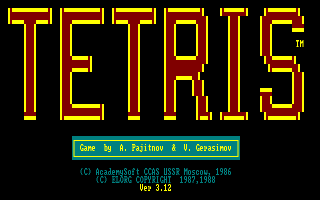 ▶Tetris1985MS-DOS / PC
 ▶Teenage Queen1988MS-DOS / PC
 ▶Boulder Dash1984MS-DOS / PC
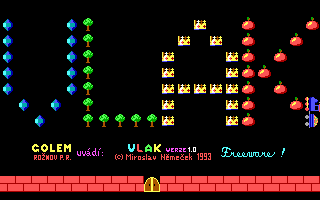 ▶Vlak1993MS-DOS / PC
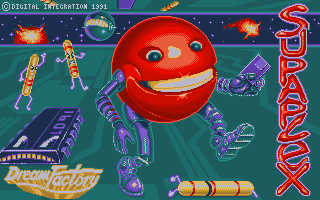 ▶Supaplex1991MS-DOS / PC
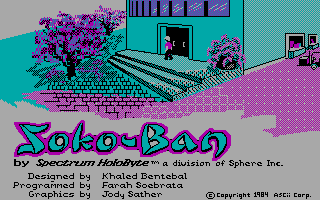 ▶Sokoban1984MS-DOS / PC


 ▶Boulder Dash III1986ZX Spectrum


