Ta recenzja nie została jeszcze przetłumaczona — pokazujemy oryginał (English).
Year 1984, BBC Micro, and two British students named Braben and Bell release a game that doesn't fit into any category. We'd have to wait until 1987 for the PC version, but the principle remains the same: you're sitting in the cockpit of a wireframe spaceship model and the world is open in a way almost nothing else was back then.
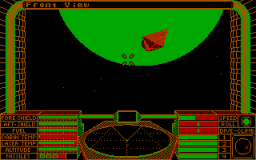
Elite is a space trading and combat simulator with an open world. You play a cosmic pilot who starts with a basic ship, a few credits, and eight galaxies containing hundreds of planets. The goal is simple on paper: climb the ranks to reach the legendary Elite title. How you do it is entirely up to you. Trade legally, smuggle drugs and weapons, hunt pirates for bounty, or become a pirate yourself.
PC controls aren't a walk in the park, especially without a joystick. A keyboard for space combat feels like operating with a scalpel while wearing gloves. But once you get the hang of it, a system opens up that was brutally complex for its time — it handles hyperspace, planet market prices dependent on their economy, ship damage, weapons, fuel. No quest markers, no tutorials. Read the manual, or die trying.
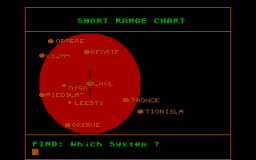
What Elite brought to the table cannot be overstated. At a time when the game industry was dominated by platformers and arcade clones, this was a different way of thinking. A procedurally generated universe in a machine with kilobytes of memory was a technical trick that commands respect even today. Wireframe 3D graphics look like a technical drawing now, but back then those fast-spinning objects in black space felt like the future. The music and sounds on the PC version are modest, no denying that.
More than just graphics has aged. Planet economies are basically number tables that repeat by template, combat gets tediously drawn-out in later phases, and the game tells you nothing — not where the better trade routes are, not that your own autopilot is robbing you blind. Anyone who loves gaming history and wants to understand where No Man's Sky, Freelancer, or Elite Dangerous come from needs to play this. Anyone looking for a relaxing weekend experience should look elsewhere.
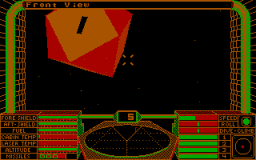
Today I'd recommend it to anyone who loves the origins of things. You can play it in your browser without installation, and the first twenty minutes — first takeoff, first hyperspace jump, first trading profit — are worth experiencing even in 2024. Then you decide for yourself if you'll stick with it.
 old
old


 ▶Pinball Fantasies1992MS-DOS / PC


 ▶LHX Attack Chopper1990MS-DOS / PC

