Year 1990, I'm sitting at my 386 trying to figure out why my ship keeps running out of food and the crew starts grumbling somewhere off the African coast. Uncharted Waters from KOEI taught me more about ocean navigation back then than geography class in elementary school — and that's both a compliment and a warning.
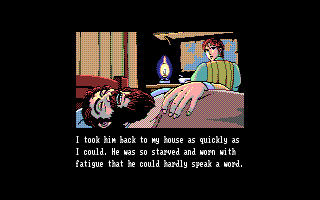
It's a nautical simulator set in the age of great exploration voyages, in fifteenth-century Lisbon. You play as a young nobleman whose family has lost both glory and fortune, and your father — inspired by the contemporary fervor for new trade routes — sets out toward unknown waters. He doesn't return. The rest is up to you. Restore your family's honor, discover new ports, earn enough money for a better ship, and maybe figure out what happened to your father.
KOEI had a peculiar fondness for games that teach you patience before anything else. Uncharted Waters is no exception. You trade between ports, hire a crew, manage supplies, sail with consideration for wind and ocean currents. The controls are fairly accessible given how many variables the game tracks simultaneously — but it takes a while to understand that ignoring water supplies or crew morale is a quick path to game over in the middle of the Atlantic. Battles with pirate ships are simple, but their simplicity doesn't diminish the tension when you're piloting a half-broken brig with minimal gunpowder.
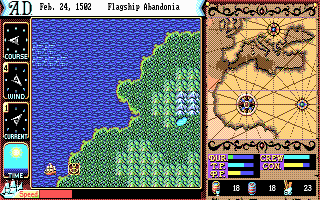
What Uncharted Waters brought to the table back then was the feeling of a real world that continues on even while you're sitting in port. Other captains are sailing, commodity prices shift, ports have their own moods. By 1990 standards, it was a remarkably living system. Today, the game has obviously aged — the graphics are modest even by period standards, the pace is slow and somewhat repetitive, and if you're not willing to accept a certain amount of menu clicking without immediate rewards, you'll get bored quickly. But whoever has that patience will find inside a surprisingly functional exploration-trade-upgrade loop.
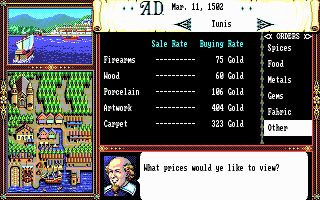
Today Uncharted Waters will suit people who love games with open-ended structure and a bit of management thinking — and who don't depend on modern conveniences like quest markers or autosave. You can run it in the browser through online DOSBox emulators and the barrier to entry is minimal. Before you jump in, though, I'd recommend finding at least a basic guide to supply management. Otherwise, your first crew will probably let you die of thirst somewhere near the Canary Islands — just like mine did back then.
 old
old


 ▶Free Croatia (DOS game)MS-DOS / PC
 ▶Pinball Fantasies1992MS-DOS / PC


 ▶Porky's Strip Poker1993MS-DOS / PC

