The box says Civilization. Your instincts say Sid Meier. They are wrong. Advanced Civilization has nothing to do with the turn-based strategy that ate your weekends in 1991. This is Avalon Hill's 1995 PC conversion of their own tabletop beast — a board game so dense it came with a cloth map, stacks of cardboard tokens, and the implicit understanding that you were clearing your entire Saturday for it.
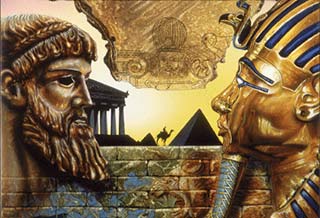
The game is rooted in ancient history, roughly spanning the early Bronze Age through classical antiquity. You pick a civilization — Egyptians, Babylonians, Illyrians and others — and compete to advance through a technology tree while managing population, trade, and a relentless deck of calamity cards. Famine. Epidemic. Civil war. The game punishes growth almost as much as it rewards it, which is either brilliant design or a slow form of cruelty, depending on your mood at the time.
The PC version handles the bookkeeping that made the tabletop original such a logistical ordeal. Trading, commodity management, calamity resolution — the computer tracks all of it. What it cannot do is replicate the negotiation across a real table, the bluffing, the side deals, the moment someone trades you a stack of identical commodities knowing full well that triples trigger a disaster. Against the AI, that entire social layer collapses. The game becomes a puzzle rather than a contest. A slow, methodical, largely solitary puzzle. The interface is functional in the way that a filing cabinet is functional — it does the job, it has no charm whatsoever, and the mouse cursor moves across it like it owes the screen an apology.
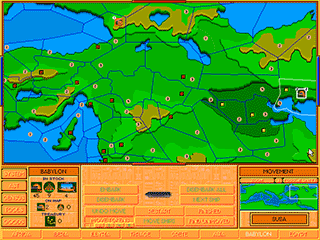
What it does preserve is the weight. Advancing your civilization through the technology tree — agriculture, metallurgy, written record, philosophy — carries genuine consequence. Each card reshapes what you can do and how you survive the next calamity. There is a slow satisfaction in watching a coastal trading culture outlast a military neighbor who expanded too fast and starved. It takes time to feel that satisfaction. A lot of time. This is not a game you finish before dinner unless dinner is very, very late.
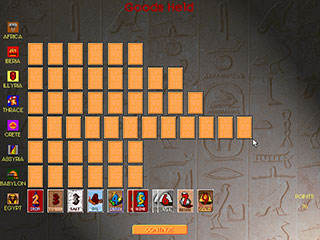
Age has not been kind to the presentation. The graphics were pedestrian in 1995 and look like a geology textbook illustration today. The AI is predictable once you understand the priority logic behind its decisions. And without human opponents, the trade phase — arguably the heart of the whole experience — loses most of its teeth. What remains is still a remarkably faithful conversion of one of the most complex board games ever published, and if you find it in the browser, it is worth at least one session just to understand what "civilization game" meant before Firaxis defined the term for everyone else. Come in with patience and low expectations for spectacle. Leave with an appreciation for why people used to clear their entire Saturdays for a cloth map and a stack of cardboard.
 old
old
 ▶Prince of Persia1990MS-DOS / PC
 ▶Prehistorik 21993MS-DOS / PC
 ▶Commander Keen 4: Secret of the Oracle1991MS-DOS / PC


 ▶Dangerous Dave in the Haunted Mansion1991MS-DOS / PC
 ▶Toy Story1995Sega Mega Drive

 ▶Sonic 3D Blast1996Sega Mega Drive
 ▶Ghouls 'n Ghosts1988Sega Mega Drive


 ▶Earthworm Jim1994Sega Mega Drive