Pirate. When my fifth-grade teacher asked what we wanted to be, I didn't say it out loud — but I was thinking it. And then KOEI showed up with Uncharted Waters 2: New Horizons, and suddenly I could be a pirate, a merchant, and a cartographer all at once without ever leaving the basement with my computer.
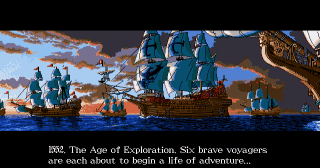
New Horizons is a nautical simulator set during the age of overseas exploration, released in 1994 in Japan, available in English a year later. KOEI, then renowned mainly for historical strategy games like Romance of the Three Kingdoms or Nobunaga's Ambition, went all-in on freedom and sandbox gameplay here. The game offers several playable characters with different motivations — corsair, merchant, cartographer, traveling nobleman — and each has their own way to make a name for themselves on the turbulent waters of the sixteenth century.
The heart of the game is sailing across a world map, trading between ports, naval combat, and gradually upgrading your fleet. The economic layer is solid — you buy cheap, sell dear, watch what's in demand where. Battles play out in turn-based tactical fashion and have decent depth. The cartography section, where you chart coastlines and sell maps, is something I hadn't seen anywhere else at the time. PC controls are serviceable, though the interface makes it perfectly clear the game's origins are Japanese and console-based.
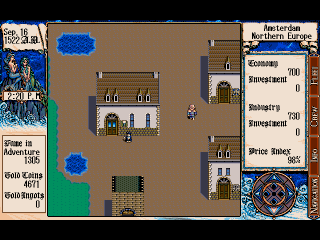
What set New Horizons apart from the crowd was that blend of genres and freedom in how you approached things. Want to plunder Spanish galleons? You could. Prefer a quiet merchant's life? That worked too. In 1995, that wasn't a given. Today the game has aged visibly — the pace is slow even by period standards, ocean navigation can feel repetitive, and the interface will forgive you almost anything except impatience. Graphics are functional, nothing more.
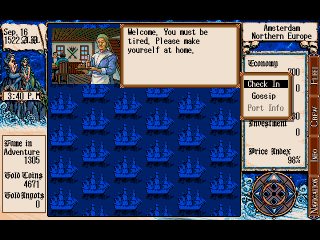
Today it'll appeal to anyone who loved Pirates! by Microprose and wanted more economic depth, or anyone who enjoys those old KOEI management behemoths. It runs without a hitch in DOSBox, and you can play it in your browser through emulators on archive servers. Remember: this isn't an action game — it's one that rewards patience and systematic thinking. I never finished it back then. But I remember it.
 old
old


 ▶Cartooners1989MS-DOS / PC


 ▶Alter Ego1986MS-DOS / PC


 ▶Cross Country Canada1991MS-DOS / PC
