old
The Complete Guide to the Birth of Grand Theft Auto (1997)
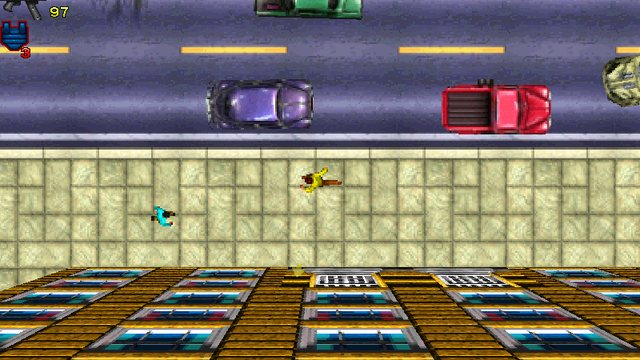
Before Grand Theft Auto became a billion-dollar 3D colossus, it was a cheeky top-down game from 1997. And yet it already had almost everything that made the series famous: an open city, stolen cars, jobs for the mob and the freedom to do whatever you want – including getting into serious trouble with the police.
| Developer | DMA Design (now Rockstar North) |
|---|---|
| Publisher | BMG Interactive |
| Released | 1997 (PC), 1998 (PlayStation, Game Boy Color) |
| Genre | action / open-world |
| Perspective | top-down 2D |
| Working title | Race'n'Chase |
| Expansions | GTA: London 1969 (1999), London 1961 (free) |
| Sequels | GTA 2 (1999), GTA III (2001) |


GTA screenshots from our database.
How a police game turned into GTA
Development started on 4 April 1995 at DMA Design in Dundee — the same people who had made Lemmings. The working title was Race'n'Chase, and you played as police officers chasing criminals. David Jones named Pac-Man as the inspiration at the time: you drive, you collect, and something chases you.
Chasing criminals turned out to be dull, so the team flipped it. The player was handed the other side, and the game found the shape the whole world now knows. The rest of development was evidently a slog. Milestones slipped one after another and the project came close to cancellation more than once. Project leader Keith Hamilton put it drily in early 1997: "GTA was harder than we thought. We're rewriting the handling of the cars." All told it took about two and a half years.
Who was there
| Person | Role |
|---|---|
| David Jones | producer, founder of DMA Design |
| Keith R. Hamilton | project leader and programmer |
| Gary Penn | creative director at the studio |
| Mike Dailly | developer (published the original design documents in 2011) |
| Brian Baglow and Brian Lawson | writing and dialogue |
The game shipped in Europe on 28 November 1997 through BMG Interactive; in North America the PlayStation version was handled by Take-Two Interactive — the company GTA would later turn into an empire.
What GTA is about
You play a small-time criminal trying to work your way up. You watch the city from above, steal your first car and drive to ringing phone booths that hand out underworld jobs – deliver goods, take someone out, steal a specific car. Money and "points" move you forward; once you collect the target amount, the next city opens up.
Between missions there is freedom: you can just run wild, collect bonuses and hunt for hidden secrets. Push it too far and the police come after you – and at higher wanted levels the FBI and the army too. Death = "Wasted", arrest = "Busted".

Three cities, three moods
| City | Based on | Atmosphere |
|---|---|---|
| Liberty City | New York | a grimy metropolis and the mob |
| San Andreas | San Francisco | hills, trams, gangs |
| Vice City | Miami | sun, beaches, drug cartels |
Do those names ring a bell? No wonder – Liberty City, San Andreas and Vice City became the settings of the later 3D installments and are cult brands today.

Points, bonuses and Kill Frenzy
- Score multiplier – completing jobs raises your multiplier, so taking risks pays off.
- Kill Frenzy – a time-limited rampage where your task is to destroy something or someone.
- Hidden bonuses scattered around the city reward exploration.
- "Gouranga!" – run over an entire line of Hare Krishnas and the game shouts a bonus at you. A legendary moment.

Cars, tanks and ambulances
You can steal practically anything with wheels – from sports cars through buses and trucks all the way to a tank. Every vehicle handles differently and some have a special function (police car, fire truck, ambulance). The car radio plays its own stations with original music – an idea that still drives GTA today.
Radio and music
Every car has its own radio with several stations and original music across genres. This little detail brought the city to life and became a trademark of the whole series – in later installments the radios even played licensed hits.
Tips for getting started
- Keep a car close at hand – on foot you are an easy target.
- Watch your multiplier: the higher it is, the faster you reach the target amount.
- A high wanted level means the FBI and the army. When things get rough, respray the car at a paint shop and you will shake off the police.
- Look for hidden bonuses and Kill Frenzies – they are quick money.

System requirements (period)
| Item | Recommended |
|---|---|
| Processor | Pentium 60–100 MHz |
| Memory | 16 MB RAM |
| System | MS-DOS / Windows 95 |
| Media | CD-ROM |

Versions, ports and expansions
GTA was released on PC (DOS/Windows), PlayStation and even the Game Boy Color. Two years later came two expansions: GTA: London 1969 (paid) and London 1961 (free) – they move the action to London, with swapped cars and a 1960s atmosphere.

The scandal that launched the game
GTA drew outrage over its violence and criminal theme. The publisher even hired the famous PR expert Max Clifford to fan the controversy – and it worked perfectly. The indignation of politicians and the media gave the game the best advertising it could ever get, and GTA became a smash hit. Some countries censored the game (for example by swapping pedestrians for zombies).

How GTA turned out
The little top-down game became an unexpected hit. GTA sold millions of copies, launched one of the most profitable game franchises in history and helped shape the open-world genre. Critics and players praised its freedom and cheek – and the later 3D installments turned that idea into a global phenomenon.
The series over time
- 1997Grand Theft Auto – the top-down original where it all began.
- 1999GTA 2 and the London expansions – still top-down, but more polished.
- 2001GTA III – the jump to 3D that changed gaming forever.
- 2002Vice City – neon-soaked '80s and a massive success.
- 2004San Andreas – three cities in one sprawling state.
- 2013GTA V – one of the most profitable entertainment products in history.
Did you know?

Music and radio
Instead of a single soundtrack, GTA came with in-car radio stations – each with its own genre and (in the first installment) original music. The idea became a trademark of the series, and in later installments the radios also played worldwide hits.
Reception and legacy
The cheeky top-down game grew into one of the most successful brands in the entertainment industry. GTA III (2001) moved the formula into 3D, and countless games now copy the GTA-style open world.
GTA 1 on video
This is what the very first installment looked like:
More videos (they open in a YouTube search):
Secrets and trivia
Glossary
| Term | What it means |
|---|---|
| Open-world (sandbox) | An open city where you roam and raise hell freely. |
| Wanted level | How hard the police (and later the FBI and the army) are after you. |
| Top-down | A view from above, like looking at a map. |
| Kill Frenzy | A timed challenge to destroy as many targets as possible. |
| Respray | A paint job at a garage that shakes off the police. |
Frequently asked questions about GTA
Who created GTA?
What was the first GTA like?
Why was GTA controversial?
What platforms did GTA 1 come out on?
When did GTA go 3D?
What does "Gouranga" mean?
Check out the origin
See where the series began. You will find more action classics in the action games section.