Year 1984. Before I first ran into Sopwith, I believed that flying in a computer required at least some disk loading time and a decent amount of patience. Sopwith proved me wrong — it was there instantly, simple and ready to kill you with your own incompetence at pulling into a climb.

BMB Compuscience released this thing for MS-DOS at a time when nobody seriously thought about 3D flight sims. Sopwith is straightforward horizontal action: you pilot a World War I biplane, shoot at enemy aircraft and ground targets, try not to flip over and land in one piece. The graphics are wireframe, monochrome, and the air around you is made of eternal gray void. Yet it works.
Controls are just a handful of keys — climb, dive, throttle, shoot, barrel roll. That barrel roll is the heart of the game. You spin the plane in a loop, momentarily ending up inverted and having to quickly compensate for altitude, or you end up in the dirt. At first, every other player does this. Then once in a while you nail the maneuver cleanly and you feel like the Red Baron. This loop — mess up, try again, pull it off — keeps the game alive more than anything else. Shooting is straightforward, enemies are predictable, but the terrain and physics punish you for every moment of carelessness.
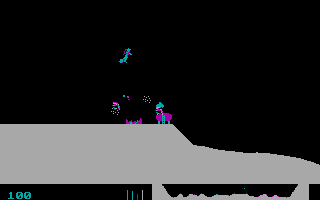
Sopwith is remembered mainly because it existed at a time when nothing comparable existed on such weak hardware. It took up almost no space, required nothing special, and yet had this loop you kept coming back to. Today the graphics are of course ancient and the sounds are exactly what you'd imagine under the word "beeping". But the gameplay hasn't aged so badly — it's straightforward, understandable, and has that one thing every good action game needs: the moment when you first make the right move at exactly the right time.

Today Sopwith suits anyone who wants to understand where action games came from before they had pixels. Fire it up in your browser in thirty seconds and in another five minutes you'll understand why people have been talking about it for forty years. It's not about nostalgia — it's that the core principle is still readable and slightly devious. Exactly as it should be.
 old



 ▶Bubble Bobble1989MS-DOS / PC


