The screen goes black. A red rectangle appears in the center—a door, presumably—and you're staring at it with the same expression as someone handed a puzzle box in a language they don't speak. Red Door, 1987, Tom D. Frost. The Spectrum's library is stuffed with mystery doors and cryptic logic games, but this one left almost no footprints. No manual survived. No screenshots in magazines. Just the name and the vague sense that something happened here, in pixels, three decades ago.
What remains is a logic puzzle game, the kind the Spectrum did obsessively well. No narrative fluff, no adventure sequences—just rooms, objects, rules you have to deduce by trial and error. You interact with the environment, manipulate things, look for the pattern. The red door itself is your exit; getting there is the whole point. Whether it's a single-room puzzle or a sprawling gauntlet of ten levels, the source material doesn't specify, and the game won't tell you either.
The interface is pure Spectrum austerity. Commands typed out, feedback sparse. There's no handholding, no indication whether you're three moves away from the solution or completely wrong. This was the era when games assumed you had patience and a notebook, when "try everything" was a legitimate strategy. The puzzle logic itself—what little can be inferred—demands lateral thinking. Combine objects? Trigger sequences? Move things in the right order? The game keeps its cards face-down.

Red Door vanished almost immediately, swallowed into the catalogue of forgotten Spectrum titles. Thousands were published; most were mediocre. This one might have been brilliant or utterly incoherent—there's genuinely no way to know now. What matters is what it represents: a moment when independent developers threw experiments at Spectrum users with minimal marketing and no safety net. Most failed. Some didn't. Red Door became a ghost story, referenced but unseen.

If you're the type who boots up obscure Spectrum games through emulation out of archaeology rather than entertainment, Red Door scratches that specific itch. It's a puzzle, probably fair, definitely opaque. No nostalgia required—just the knowledge that somewhere in the early eighties, someone coded this, believed in it enough to release it, and then disappeared. The red door is still there, waiting. Whether it's worth your time is a puzzle in itself.
 old
old ▶Boulder Dash III1986ZX Spectrum
 ▶Boulder Dash VI1992ZX Spectrum
 ▶Animated Strip Poker1985ZX Spectrum
 ▶Spectrum Scramble1982ZX Spectrum
 ▶Critical Mass1985ZX Spectrum
 ▶Makao1985ZX Spectrum
 ▶Boulder Dash V1992ZX Spectrum
 ▶Nicotine Nightmare1985ZX Spectrum
 ▶Strip Black-Jack1986ZX Spectrum
 ▶Strip Game1988ZX Spectrum
 ▶Atomix II - Hexagonia1991ZX Spectrum


 ▶Tetris1985MS-DOS / PC
 ▶Boulder Dash1984MS-DOS / PC
 ▶Teenage Queen1988MS-DOS / PC
 ▶Vlak1993MS-DOS / PC
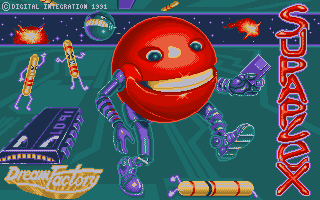 ▶Supaplex1991MS-DOS / PC