Bookwyrm drops his storybook and suddenly Jack is climbing a beanstalk into a gingerbread house while Cinderella's glass slipper ends up somewhere it has absolutely no business being. That's the pitch, and Sierra committed to it fully.
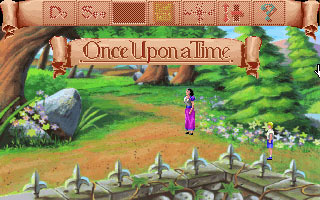
Mixed Up Fairy Tales, released in 1991, is a point-and-click adventure aimed squarely at kids — the kind who could barely reach the keyboard. Sierra's AGI successor, SCI, was running the show by then, so the visuals are clean and colorful by early-nineties standards. The premise is simple: a dragon called Bookwyrm has scrambled a pile of classic fairy tales, mixing up characters, objects, and locations across stories. Your job is to sort out the chaos and put everything back where it belongs — or close enough.
The interface strips things down to the bone. Big icons, minimal text, no parser to wrestle with. You click on things, pick up objects, hand them to characters who look at you like you've lost your mind until suddenly you haven't. The puzzle logic is gentle, built around matching scrambled pieces back to their rightful tales. It never asks much of you, which is either a virtue or a flaw depending on how old you are. At eight, it feels like detective work. At forty-two, it's closer to sorting socks.
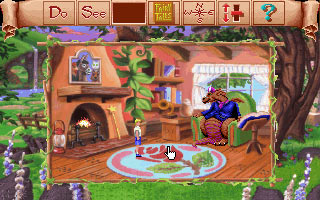
What Sierra understood here — and it's easy to underestimate this — is that young kids don't need challenge, they need agency. The feeling that clicking on something actually does something, that the world responds. Mixed Up Fairy Tales delivers that in steady doses. The humor is dry enough that a parent sitting behind the kid won't fall asleep entirely. Bookwyrm has the energy of a middle manager who's just watched his entire filing system get thrown down a stairwell, and the scrambled scenarios land with a quiet absurdity that still works. Cinderella negotiating with the wrong prince in the wrong kingdom because some dragon sneezed — there's a comedic rhythm to it that doesn't condescend.
It has aged the way most children's software ages: gracefully for what it is, but only if you meet it on its own terms. The pacing is slow by any modern measure. The puzzles won't tax a grown adult for more than a few minutes. The sound, running through a Sound Blaster in 1991, had that particular FM synthesis warmth that either takes you straight back to a specific afternoon or means absolutely nothing to you. There's no middle ground.
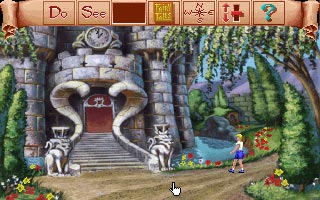
Today it plays best as something you sit through with a young kid nearby — five, six, maybe seven. Let them click. They'll figure it out faster than you expect and feel good about it, which was the whole point. In a browser it runs fine, needs no setup, and takes maybe ninety minutes to finish. That's not a complaint. Some stories are the right length.
 old
old ▶Amazing Spider-Man1989MS-DOS / PC


