Year 1993, I'm sitting in front of my monitor and instead of shooting aliens, I'm building a car factory. My friends didn't get it. Detroit from Impressions Games was the type of game that pulled you in not through action, but through the quiet satisfaction of a well-tuned production line.

The game throws you at the turn of the nineteenth and twentieth centuries, a time when the automobile industry was just finding its shape. You start with essentially an empty lot and the ambition to become the next Ford — figuratively speaking. You pick a location, build a factory, decide what you're going to manufacture, and then watch to see if anyone actually dares to buy it. It's a management simulator in the spirit of Impressions' games from that era, who were churning out similar builder-economy titles like they were on an assembly line themselves.
The core of the game is balancing vehicle development, price, and production capacity. Set the price too high and the warehouse fills with unsold automobiles. Invest in research and only a thin margin saves you from bankruptcy. The development cycle has its rhythm — nothing happens fast, and that's by design. The controls are standard period interface with menus and icons, nothing that'll break your fingers, but nothing that'll dazzle you with design either. 1993 was simply 1993 in that regard.
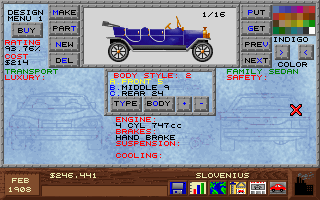
What Detroit did better than many competing titles was grounding itself in a concrete historical period. It wasn't abstract company-building in timeless void — you felt like you were standing at the beginning of the industrial revolution, where every decision could mean rise or ruin. Today the game looks modest and some mechanics feel simplified, but that's true for most simulators of that era. It ages decently — not triumphantly, but decently.
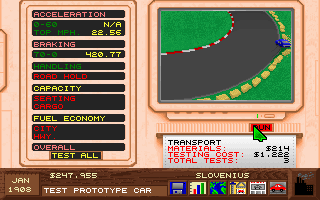
If you enjoy economic simulators and are curious what the genre looked like before the era of complex spreadsheet interfaces, Detroit is a compact and playable piece. It's not Transport Tycoon, but it does its job. You can play it in your browser for an afternoon and come away with a rough idea of why the automobile industry was never as simple as it looks on an advertisement poster.
 old
old


 ▶Cartooners1989MS-DOS / PC


 ▶Alter Ego1986MS-DOS / PC


 ▶Cross Country Canada1991MS-DOS / PC


