Deze recensie is nog niet vertaald — we tonen het origineel (English).
1990, it's raining outside, there's cold tea on the table, and I've spent the last half hour trying to figure out what the UMS II manual actually wants from me. Not out of stupidity — on principle. This game assumes you know what you're doing. And if you don't, please go read the first installment from 1988 as homework.
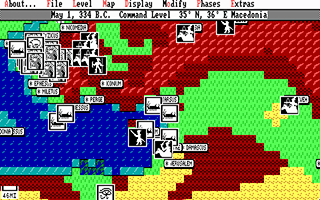
UMS II: Nations at War is a turn-based command strategy from Intergalactic Development that attempts to simulate military conflicts at the operational and strategic level. There are no units on a hex grid where you push pawns around like in Panzer General — here you're directing army movements, supply lines, morale, and logistics. The setting isn't arbitrary; the game offered multiple historical and hypothetical scenarios, so one day you're fighting Napoleonic Wars, the next you're dealing with a modern conflict. An ambitious undertaking, that's for sure.
Gameplay works on a phase system — you give orders first, then the game resolves them. The interface is typical for its era: a series of menus, text information, minimal graphics. The map is schematic, units are more symbols than figurines. Anyone expecting something in the style of Civilization, which Sid Meier released a year later, would be disappointed. But if you came from tabletop war games and wanted the same thing in digital form, you had reason to stay. The problem is, the game barely tells you anything at first — the learning curve is as steep as the Alps in February.
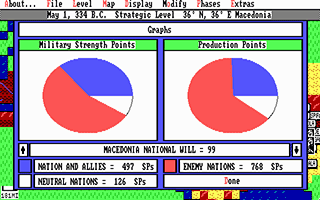
Compared to the first installment, what's been added is primarily an expanded scenario database and improved modeling of nations and their properties. Whether that's enough for a proper sequel depends on how much the original UMS grabbed you. If you loved the first game, you'll find more content in the same package. If you didn't know it, you'll be lost. Graphics and sound are exactly at 1990 level — basically nonexistent as an entertainment element, purely functional. Time has added harshness, not charm.
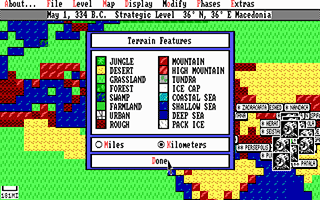
Today UMS II appeals to a narrow circle of players: those with patience for abstract systems, who love military history for its own sake, and don't mind that the game communicates more like a military report than an interactive experience. You can run it in a browser via DOSBox without much trouble, but expect to spend the first hour reading rather than playing. For collectors of period strategy games, it's a historical artifact with real value. For everyone else, there are more accessible alternatives.
 old
old


 ▶Teenage Queen1988MS-DOS / PC


 ▶Chess1998Sega Mega Drive


