Deze recensie is nog niet vertaald — we tonen het origineel (English).
Sometime in the mid-nineties, I sat in front of a monitor, rotating clusters of colored blocks back and forth, convinced that the solution had to be within reach. It wasn't. Clockwiser by Team Hoi from 1994 is exactly the kind of game that looks trivial and then steals an hour of your afternoon before you realize it.
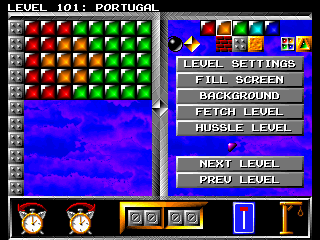
The principle is pure, almost brutally so. On the left you have a set of blocks in a certain arrangement, on the right a target pattern you need to match. The only tool at your disposal is rotation — you select a group of blocks and spin it clockwise or counterclockwise. Hence the name. No moving pieces around, no clearing, no power-ups. Just rotation and thinking.
And that's where the whole trick lies, in that minimalist toolset. Every move changes more than you expect. You make one rotation, seemingly getting closer, then realize you've scrambled a section that was already correct. The puzzle design gradually ramps up in complexity, so early levels serve more as a tutorial for your spatial reasoning than an actual challenge. Then the later ones come, and spatial reasoning alone won't cut it — you need to mentally play out four moves ahead. The controls are straightforward, mouse or keyboard, no hassles.
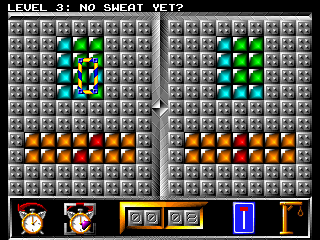
Clockwiser isn't a game people talk much about nowadays, and I get why. It didn't come with a story, atmosphere, or a soundtrack that would stick with you. The graphics are functional in the most literal sense — blocks are blocks, background is background. On the flip side, the genre doesn't mind. Abstract puzzles don't need narrative fluff. What keeps your attention here is pure mechanical problem-solving, and it's aged surprisingly well. Rotational puzzles as a concept are timeless — look at all those modern mobile games that came up with the same idea twenty years later and acted like they invented it.
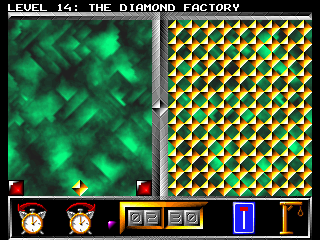
Today you can play Clockwiser in your browser via DOSBox emulators without any installation. It suits anyone who loves clean logic games without unnecessary packaging — and doesn't mind getting soundly beaten by a piece of software from 1994. I'd recommend budgeting more time than seems reasonable.
 old
old


 ▶Tetris1985MS-DOS / PC
 ▶Boulder Dash1984MS-DOS / PC
 ▶Teenage Queen1988MS-DOS / PC
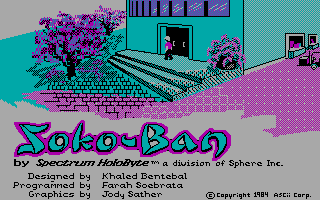 ▶Sokoban1984MS-DOS / PC
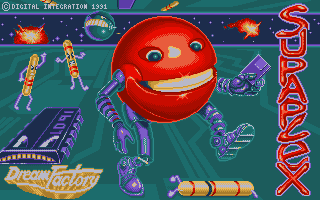 ▶Supaplex1991MS-DOS / PC
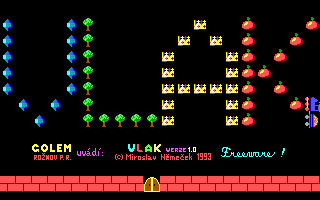 ▶Vlak1993MS-DOS / PC
 ▶Chess1998Sega Mega Drive


