If you sat down at a computer in 1986 expecting some fun, Alter Ego Male was waiting for you with a sly grin. It didn't promise you anything — and it took everything away. This text-based life simulator on IBM-compatible computers might look futuristic as a method of self-destruction, but it deserves your attention.
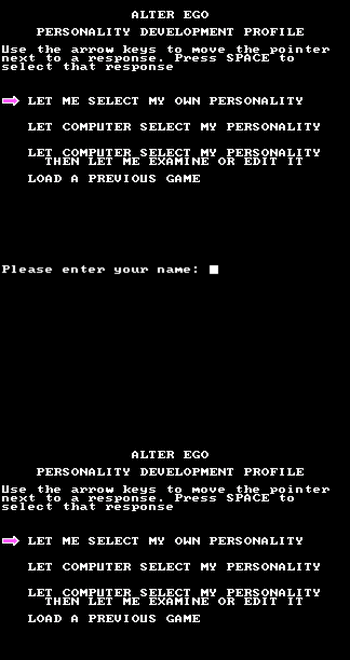
It's basically an interactive novel where you're born and have decades behind you as a man. Whenever you jump in during your life, you make decisions for your character — which school you'll choose, your job, your partners. The whole concept sounds interesting on paper. In practice, you're in for endless clicking through text menus and reading bare messages about what just happened to you in life, without having any real say in it. The game presents you with choices, then ignores them anyway.
The controls are something else — navigating text menu items drags on like a long school break. Keyboard, arrows, Enter. Over and over. Graphics are almost non-existent, more like a silent absence. Sound would be missing, but on DOS machines it was chaos anyway. Playing exhausts you not with fun, but with tedium — like someone forced you to stare at a calendar every day and wait for something to happen.
Alter Ego Male is part of the eighties' attempts to reshape what a game could be. Its predecessor Civic by American Broderbund (1985) surprisingly attracted a serious audience — so Infocom and other bold ventures thought, why not. The result is as fascinating as a scientific experiment and somehow just as dull.
Playing it today is more like remembering what it was like back then — boredom as part of technological progress. If you're curious about the origins of text-based personal life simulators and have the patience to read lines of text without a broader dramatic arc, it might grab you. Everyone else can skip it entirely.
 old


 ▶Windows 95 in the BrowserMS-DOS / PC


 ▶Pinball Fantasies1992MS-DOS / PC


 ▶Free Croatia (DOS game)MS-DOS / PC
 ▶NHL '941993MS-DOS / PC
