Questa recensione non è ancora tradotta — mostriamo l’originale (English).
The year is 1984, Scott Adams and his Adventure International. A fairly bold move for the time: take a Marvel license and cram it into a text adventure. The result was Questprobe Featuring The Hulk, the first installment of a planned series that was supposed to gradually traverse the entire comic book universe. It turned out differently, but that's another story.
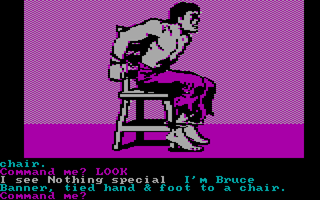
You play as Bruce Banner, literally — not as the green giant, at least not all the time. The goal looks simple on paper: collect gems and place them in the right location. What's the catch? The game won't tell you almost anything. No grand narrative, no developed plot. You're thrown into an environment that vaguely resembles comic book scenery, and you have to figure out what's actually expected of you.
The mechanics hinge on switching between Banner and Hulk. Banner has brains — he can solve problems more delicately, read situations, use objects in ways that brute force won't manage. Hulk has strength, that's clear. Switching between both forms was a clever idea on paper in 1984. In practice, it means that part of the puzzles requires figuring out which one of them even has a chance of succeeding — and the game gives you no hints except repeated failure. The Adventure International text parser was never the gentlest. You have to nail the commands exactly, or you hit a brick wall.
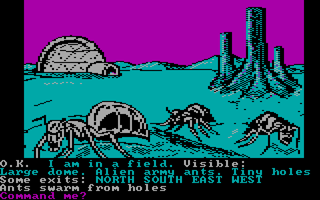
What I remember: frustration and a strange satisfaction when something finally clicked. Questprobe wasn't technically dazzling even at release — graphical versions on other platforms (Apple II, Commodore 64) looked visually better, the DOS version is austere and text-only. But the idea that you carry two different tools in one body and must know when to use which one was interesting for its time. It aged about the way you'd expect: the puzzle logic is sometimes deliberately cryptic in a way that doesn't feel like a challenge today, but rather like design without feedback.
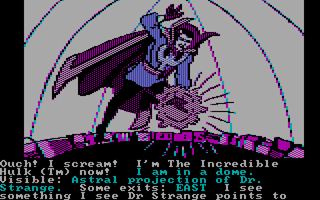
Today I'd recommend it mainly to two types of people. First, text adventure fans who want to see how Scott Adams worked within constraints — you can see it at every step here. Second, nostalgics who worshipped Marvel comics in the eighties and want to experience how licensed games were actually made back then. You can finish it in a browser in an afternoon, or maybe a week, depending on your tolerance for parser blindness. Having a walkthrough handy isn't a weakness — it's common sense.
 old
old


 ▶Amazing Spider-Man1989MS-DOS / PC


