Questa recensione non è ancora tradotta — mostriamo l’originale (English).
Hexagonal grid, two players, one question: who owns the board? I first saw Hexxagon back in '93 on a classmate's monitor, and I didn't even need the manual. That alone says something.
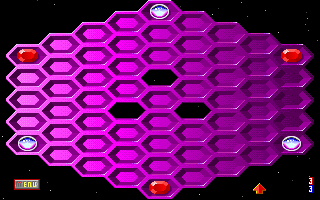
Hexxagon is a turn-based strategy game from Argo Games built on a simple principle anyone who's ever touched Othello or Reversi will recognize. The playing field is a hexagonal grid of spaces, two opponents battling for territory with colored pieces. No story, no campaign, no cutscenes. Pure abstract strategy, no apologies.
The rules fit into two sentences. Each turn you either jump a piece to a farther space and leave the original behind, or duplicate it onto an adjacent space and suddenly you've got more pieces. All enemy pieces on adjacent spaces flip to your color. Sounds trivial, and the first three moves are trivial too. Then suddenly you realize you're surrounded, and you're wondering where it all went wrong. The AI isn't some chess-engine-level deep thinker, but on higher difficulty it'll punish every bit of sloppiness. Against a live opponent on one keyboard? That's a whole different ballgame.
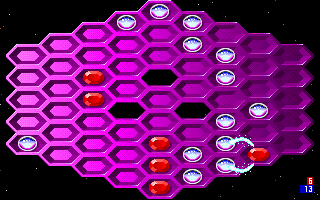
What keeps Hexxagon afloat thirty years after release is precisely that hexagonal grid. Six-sided spaces instead of squares give every move more directions, more neighbors, more things to track at once. It's not a revolutionary idea—expansion board game mechanics existed long before—but the implementation on PC was accessible and solid in 1993. The graphics are modest, the music plays its part and then falls silent, and that's about all there is to say about the technical side. It's aged exactly as you'd expect from a DOS shareware title: simple and without any pretense.
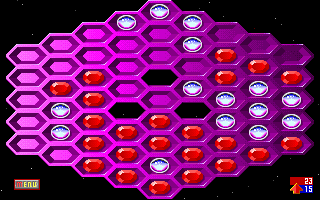
Today Hexxagon appeals to anyone with ten minutes to spare, a friend looking over their shoulder, or nostalgia for the era when "we're playing together at one computer" wasn't an exception but the rule. Fire it up in your browser, understand the rules in a minute, play five rounds, and either walk away satisfied or realize you need to win just one more. Either way, it's a legitimate reason.
 old
old


 ▶Contra1988MS-DOS / PC
 ▶Commander Keen 4: Secret of the Oracle1991MS-DOS / PC


 ▶Toy Story1995Sega Mega Drive
 ▶Dangerous Dave in the Haunted Mansion1991MS-DOS / PC


 ▶Giana Sisters1987MS-DOS / PC
