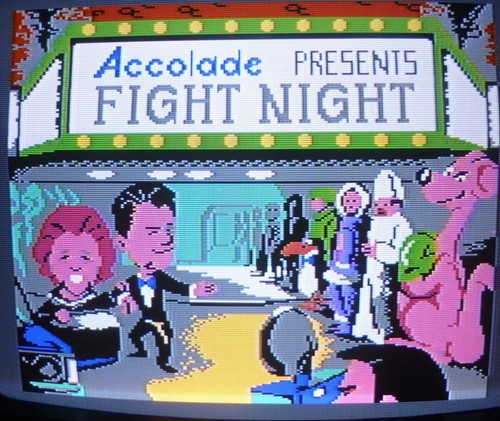
Two pixels walk into a boxing ring. One of them is you. Fight Night doesn't waste time with introductions—you're here to throw punches, and that's all this 1985 Commodore 64 slugfest wants from you. No story, no career mode, just the raw mechanics of digital violence rendered in blocky, jerky sprites that move like they're punching through molasses.

The premise is straightforward: you're a boxer facing opponents in what amounts to a series of one-on-one matches. Each bout plays out on a single screen with your fighter and your opponent trading blows. The controls let you move left and right, bob and weave, and throw punches at various heights. It's the kind of sport game that early C64 developers thought would translate well to the home computer—mechanical, turn-based in feel, with a heavy emphasis on timing rather than reflexes. Think of it as digital chess with gloves.
The actual fighting feels stiff and unresponsive by modern standards. Your boxer moves with all the grace of a wind-up toy, and the collision detection seems to have been calibrated with generous margins—you'll land hits that don't quite connect visually, and miss swings that look solid. The difficulty ramps up quickly, and not always fairly; later opponents hit harder and faster, making the whole thing feel less like learning to box and more like hoping the AI has an off day. There's no real feedback either, no satisfying thunk when you land a proper blow. Just sprites changing state and a beep from the speaker.
What Fight Night represents is the era when sports games were still finding their footing on home computers. It's not broken, exactly, but it's not fun in any way that holds up. The appeal was novelty in 1985—actually controlling a boxer at home instead of watching it happen on an arcade cabinet. Now it's a historical artifact, a reminder that early sports sims were more about systems than sensation. The game has no style, no character, nothing that makes you want to come back after the first knockout.

If you're digging through retro boxing games, there are better uses of your time. This one's worth a quick browser emulation session out of curiosity, nothing more. It's the kind of game you fire up for five minutes, remember why it faded from history, and move on. A genuine period piece, but not in the way the developers hoped.
 old
 Fight Night, Commodore 64/128, C-64/128, Accolade, 1985, Complete, Sealed, NEW広告eBayで見る »
 FIGHT NIGHT - Commodore 64 C64/128 - Rare Big Box Version - Fully広告eBayで見る »
 Fight Night (US Gold 1986) Commodore C64 (Case,Tape) Rare広告eBayで見る »
 Commodore 64 - FIGHT NIGHT Original Disk広告eBayで見る »


 ▶Little Fighter1995MS-DOS / PC


