Цей огляд ще не перекладено — показуємо оригінал (English).
Imagine yourself sitting in a cockpit with nothing but a starry sky and enemy fighters ahead of you. X-Wing Fighter from 1982 is a simple arcade shooter released by an unnamed author for IBM PC computers. It demands just one thing from you: survive and shoot.
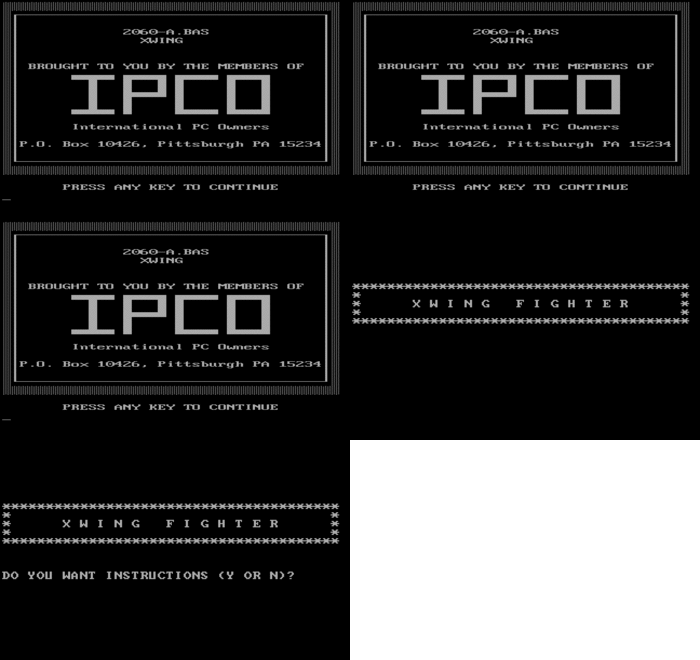
You're the pilot of a space fighter that must neutralize an incoming attack. The screen shows your forward view — enemy ships approach from above and the sides, and you have to shoot them down before they pass by your cockpit. Simple, primitive, but in the eighties, that was enough. The game has no plot, no dialogue, nothing extra. It's all about perfecting your reflexes and calculating trajectories.
The controls are straightforward — use the arrow keys to maneuver, spacebar to shoot. Enemies come in regular waves and get faster with each one. There's nothing like procedural generation or AI here — every playthrough shows the same pattern, you just need to be quicker. The graphics are minimalist, just white lines on a black background like an old oscilloscope display. Sound? Beeps and buzzes straight from the computer's internal speaker. Today it looks like something a beginner would draw in ASCII.
X-Wing Fighter is a perfect expression of archaic game philosophy — no content, just pure mechanics. It's one of those games I watched with more respect than enjoyment. I'm not sure if anyone played it voluntarily, or if it was just a party novelty on school computers. But it has that aura of something that met its time and time moved on without it.
Today it's an archive curiosity that confirms how long it took computer games to learn how to tell stories or offer anything more than repetitive challenge. If you want to play a piece of history, it's here in your browser. But you know what awaits — a half-minute that repeats until you're bored.
 old
old

 ▶Dangerous Dave1990MS-DOS / PC
 ▶The Simpsons Arcade Game1991MS-DOS / PC


 ▶Pinball Fantasies1992MS-DOS / PC


 ▶Mravenečci2026Webová hra


 ▶Star Wars1988MS-DOS / PC
